Profile
Daucus carotaDaucus carota
The carrot (Daucus carota) is a popular root vegetable plant valued for its sweetish, nutritious roots. It is relatively easy to grow and is used in many cuisines worldwide. From sowing to harvest, several important points need to be considered to obtain healthy and productive plants.
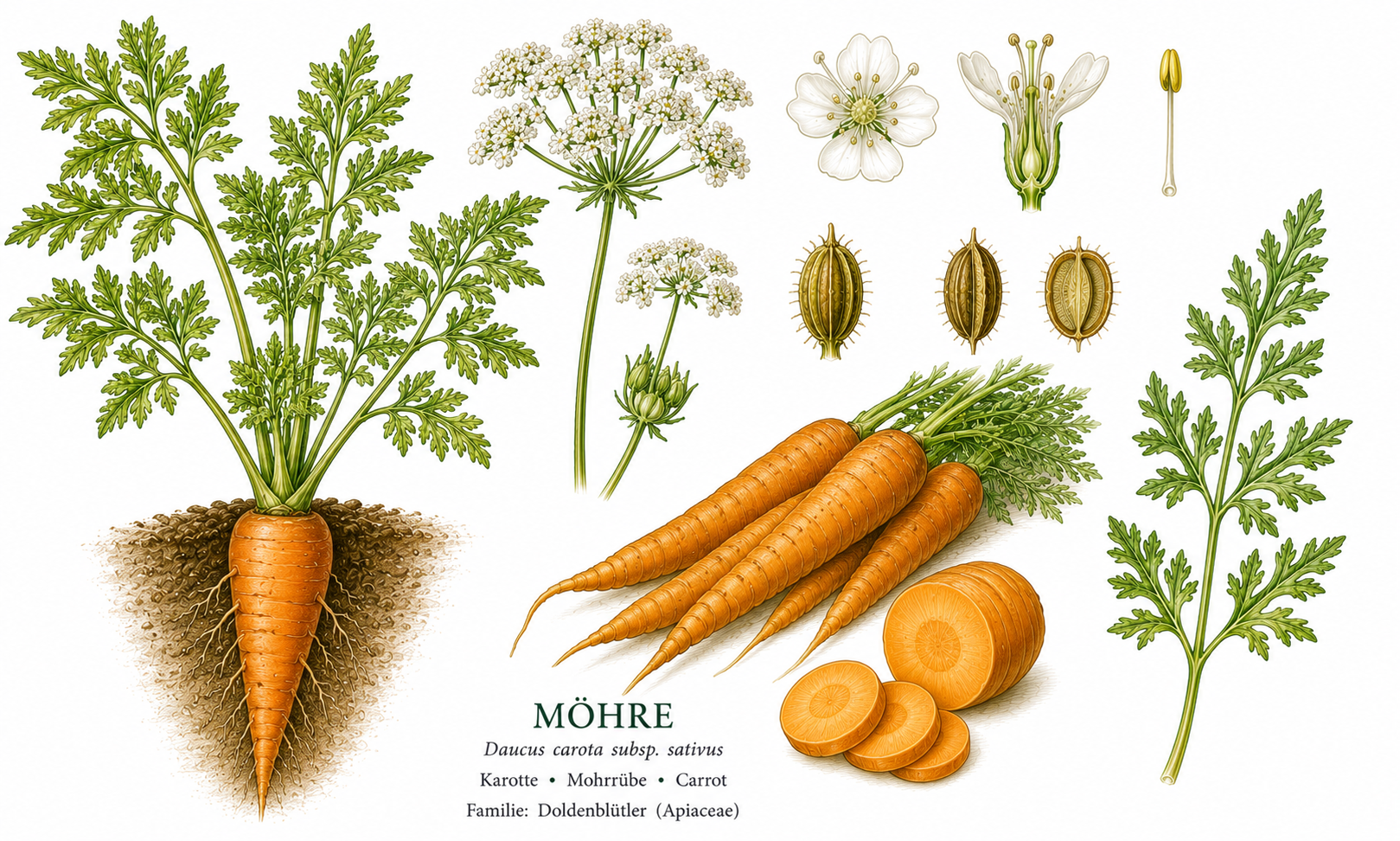
Quick profile
Key data
Harvest
January - December
Light
full sun
Water
medium
Growing data
Daucus carota Growing data
Seed depth
1 - 2 cm
Plant spacing
5 - 10 cm
Row spacing
20 - 30 cm
Germination temp
5 - 25 °C
Sowing and germination
Planting and spacing
Temperature and site
Water, nutrients and care
Container, support and growth
Year plan
Daucus carota Calendar
Indoor sowing
Carrots are generally not started indoors because they develop taproots that can be easily damaged during transplanting.
Direct sowing
Direct sowing into the open ground from April, as soon as the soil has warmed up. Earlier sowings are possible but carry a higher risk of poor germination.
Planting
Not applicable, as carrots are direct-sown.
Harvest
Harvest time varies depending on the variety and sowing date. Early varieties can be harvested as early as June/July. Storable varieties can be kept until spring of the following year.
Year plan
- Prepare soil and make first sowing
- Sowing in the open field
- Thin out sowings
- Repeat sowing
- Weed and loosen soil
- Water during drought
- Sowing for autumn harvest
- Thin out and weed
- Thin out
- Maintenance
- Start harvesting
- Prepare for storage
- Main harvest
- Final harvest
- Check storage
Growing
Daucus carota Site, soil and care
Light
full sun
Spacing
5 - 10 cm
Storage
Store cool, dark, and moist., Sand storage is ideal for long-term storage., Refrigerator storage for shorter periods.
Carrots require deep, loose, and stone-free soil. Direct sowing is the norm. Regular weeding and watering during dry spells are important. The carrot fly is a common pest that can be deterred by intercropping with onions or by using insect netting. Storable varieties can be kept well over winter.
Pruning
Daucus carota Pruning
not_applicable
Goal
not_applicable
Tools and hygiene
Not applicable for this crop.
Companion guide
Daucus carota Companion guide
Good neighbors
StrawberryRadishLettuceOnionGarlicRosmarinus tomentosusThymus
Health
Pests, Diseases
Pests
Carrot fly
The larvae of the carrot fly mine the roots, causing feeding damage that leads to discoloration and loss of quality.
Soil nematodes (e.g., carrot cyst nematode)
These microscopic roundworms damage the roots by boring into them and extracting nutrients. This leads to growth disorders and reduced yields.
Aphids
Aphids suck plant sap from leaves and stems, which can lead to growth disorders and virus transmission. They excrete honeydew, which attracts sooty mold.
Diseases
Alternaria blight
A fungal disease that primarily affects the leaves and can lead to significant yield losses.
Carrot rust
A fungal disease that appears as small, pustule-like spore deposits on leaves and stems. It weakens the plant and can affect the harvest.
Bacterial wilt
A bacterial infection that leads to wilting and rotting of the roots. It is often transmitted by injuries or pests.
Deficiencies
Boron deficiency
A lack of boron can lead to growth disorders and deformities of the roots.
Potassium deficiency
Potassium is important for root development and overall plant health. Deficiency can lead to poor root development and increased susceptibility to diseases.
Plant health
FAQ
When is the best time to sow carrots?
Carrots are sown directly into the open ground from April until July, as soon as the soil is warm enough (at least 7°C). Multiple sowings at intervals of 2-3 weeks allow for continuous harvesting.
Why are my carrots germinating poorly?
Poor germination can be due to sowing too deep or shallow, soil that is too dry or wet, unfavorable temperatures, or soil crusting. Pay attention to the correct sowing depth (1-2 cm), consistent moisture, and soil temperature (5-25°C).
How do I protect carrots from the carrot fly?
The most effective methods are intercropping with onions or leeks, covering the beds with fine insect netting to prevent egg-laying, and adhering to good crop rotation.
When and how do I harvest carrots?
Harvest time varies by variety, usually from June/July until autumn. Harvest on dry days by carefully pulling the roots from the loosened soil. Early varieties can also be harvested sooner.
Related plants
Guides
Related guides
Guide
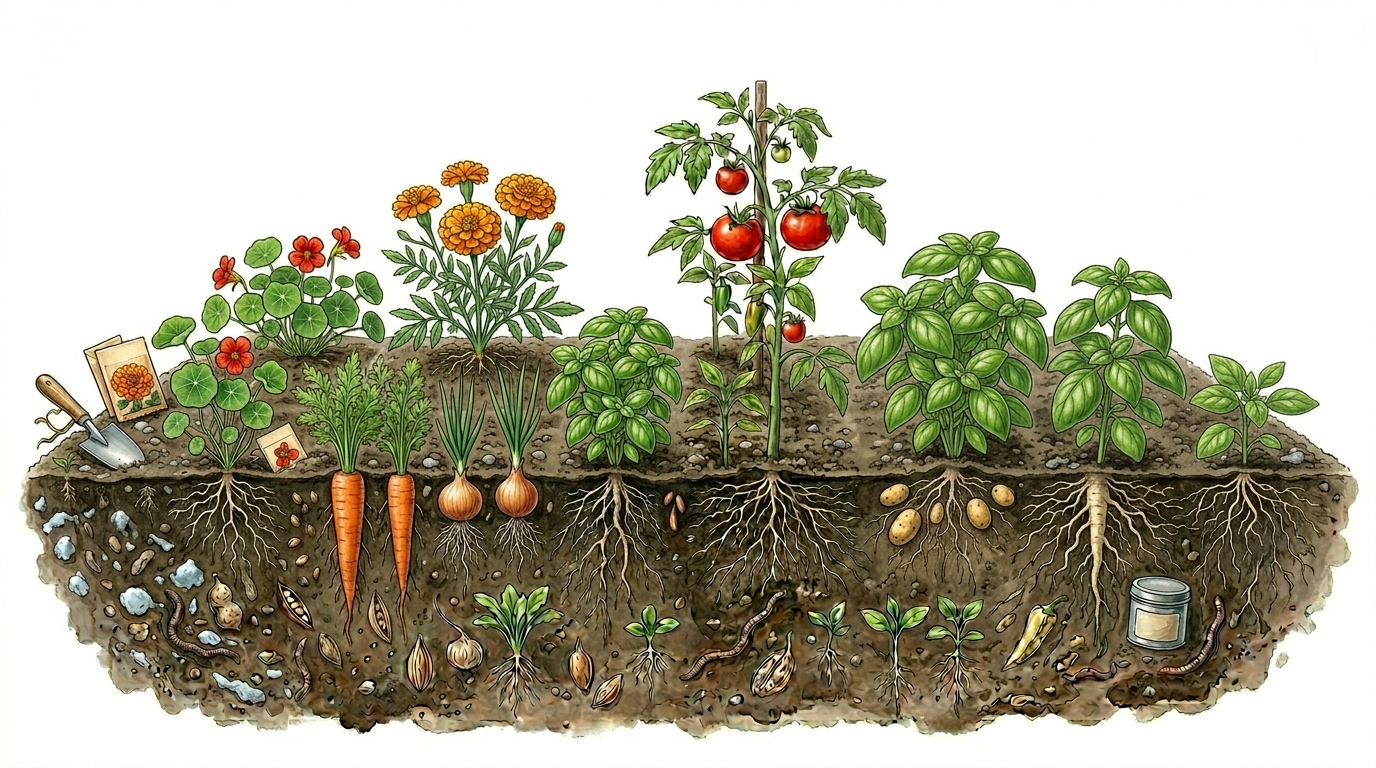
Companion Planting for Tomatoes: Good and Bad Neighbors
Learn which plants grow well with tomatoes, which neighbors to avoid, and how to plan productive mixed tomato beds.
Guide
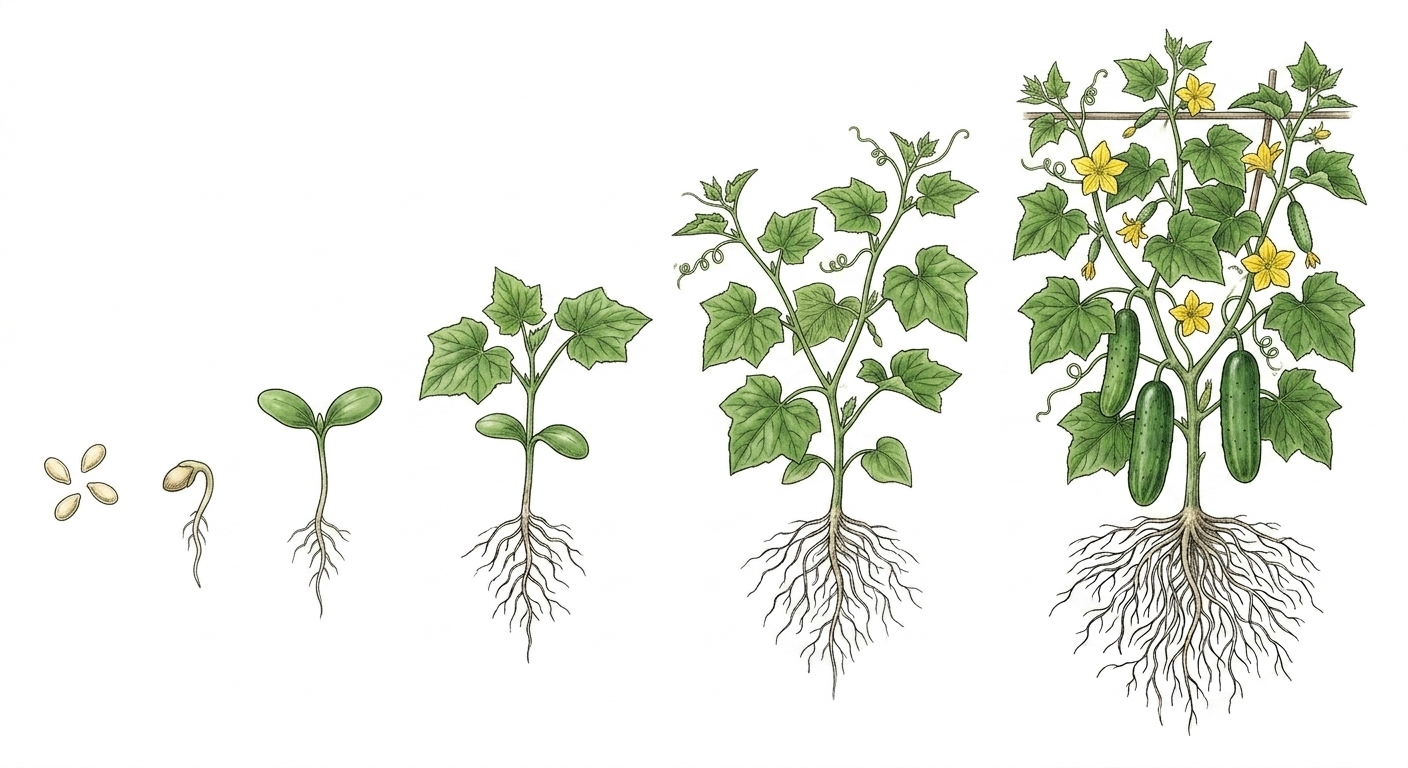
Growing Cucumbers: Starting, Supports and Harvest
Learn how to grow cucumbers successfully with indoor starting, transplanting, trellises, watering, and regular harvesting.
Guide
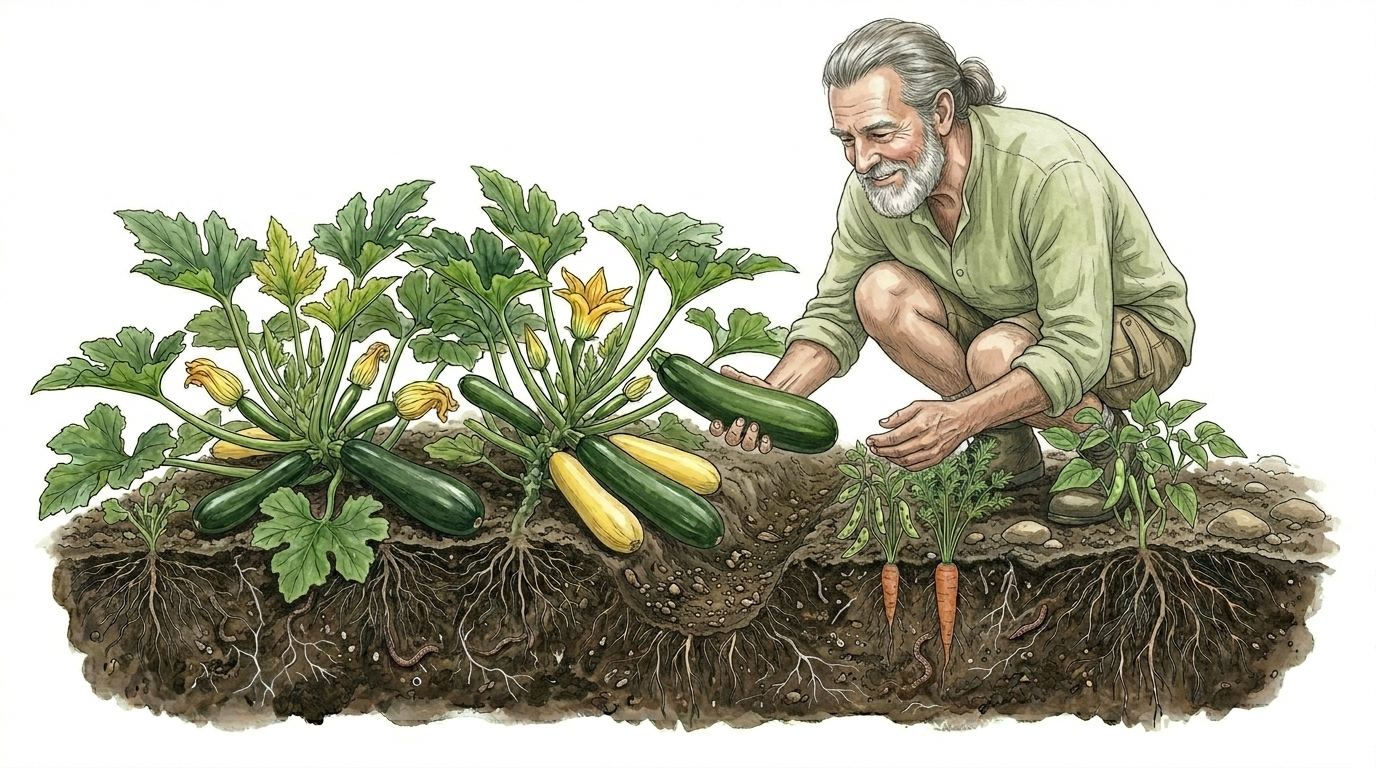
Growing Zucchini: Spacing, Pollination and Mildew
Learn how to grow zucchini with the right site, spacing, pollination support, and practical tips to prevent powdery mildew.
Guide
May Planting Calendar: Transplanting and Succession Sowing
What to plant and sow in May: transplant tender vegetables, continue succession sowing, and make the most of garden beds.
Internal links
Related plants
Sources
Public sources
- Wikidata entity
Wikidata · 2026-05-14
- GBIF species match
GBIF · 2026-05-14
- Deutschsprachige Wikipedia: Möhre (Pflanzenart)
Wikipedia · 2026-05-14
- English Wikipedia: Daucus carota
Wikipedia · 2026-05-14
Details
More public plant data
Names
Common
Daucus carota
Plural
Daucus carrots
Synonyms
- wild carrot
- European wild carrot
- bird's nest
- bishop's lace
- Queen Anne's lace
Common synonyms
- carrot
- garden carrot
Regional names
Historical names
Market names
Misspellings
Search terms
- Daucus carota
- carrot
- wild carrot
Taxonomy
Clades
- Tracheophytes
- Angiosperms
- Eudicots
- Asterids
Family
Apiaceae
Related crops
- Daucus carota subsp. sativus
Classification
Edible parts
- Root
Calendar
Sowing indoor
Notes
Carrots are generally not started indoors because they develop taproots that can be easily damaged during transplanting.
Sowing outdoor
Months
- 3
- 4
- 5
- 6
- 7
Notes
Direct sowing into the open ground from April, as soon as the soil has warmed up. Earlier sowings are possible but carry a higher risk of poor germination.
Planting out
Notes
Not applicable, as carrots are direct-sown.
Harvest
Months
- 6
- 7
- 8
- 9
- 10
- 11
- 12
- 1
- 2
- 3
- 4
- 5
Notes
Harvest time varies depending on the variety and sowing date. Early varieties can be harvested as early as June/July. Storable varieties can be kept until spring of the following year.
Month tasks
3
Prepare soil and make first sowing
4
Sowing in the open field
5
Thin out sowings
Repeat sowing
6
Weed and loosen soil
Water during drought
7
Sowing for autumn harvest
Thin out and weed
8
Thin out
Maintenance
9
Start harvesting
Prepare for storage
10
Main harvest
11
Final harvest
12
Check storage
Month tasks structured
3
- TaskBoden vorbereiten und erste Aussaat ins Freiland tätigen.
Label
Prepare soil and make first sowing
PriorityhighMonths
- 3
ConditionBoden ist bearbeitbar und nicht gefrorenEstimated effortmediumNotes
Depending on the weather, sowing can also take place at the end of February.
4
- TaskAussaat ins Freiland, dünn säen und Reihenabstand beachten.
Label
Sowing in the open field
PriorityhighMonths
- 4
ConditionBodentemperatur mindestens 7°CEstimated effortmediumNotes
For continuous harvest, several sowings at intervals of 2-3 weeks are possible.
5
- TaskVereinzeln der ersten Aussaaten, um optimalen Abstand zu gewährleisten.
Label
Thin out sowings
PriorityhighMonths
- 5
ConditionPflanzen sind ca. 5-10 cm hochEstimated effortmediumNotes
Remove the weaker plants to give the stronger specimens space to grow.
- TaskWiederholung der Aussaat für kontinuierliche Ernte.
Label
Repeat sowing
PrioritymediumMonths
- 5
ConditionBoden ist feucht und warm genugEstimated effortlowNotes
Allows for continuous harvesting into autumn.
6
- TaskUnkraut jäten und Boden lockern, um Konkurrenz zu vermeiden.
Label
Weed and loosen soil
PriorityhighMonths
- 6
ConditionBoden ist trocken genug zum JätenEstimated effortmediumNotes
Especially important while the plants are still small.
- TaskBei Trockenheit gründlich wässern.
Label
Water during drought
PriorityhighMonths
- 6
ConditionLängere TrockenperiodenEstimated effortmediumNotes
Consistent moisture is crucial for root development.
7
- TaskAussaat für Herbsternte, falls noch nicht geschehen.
Label
Sowing for autumn harvest
PrioritymediumMonths
- 7
ConditionBodentemperatur geeignetEstimated effortlowNotes
Late varieties can be sown until mid-July.
- TaskFortlaufendes Vereinzeln und Unkraut jäten.
Label
Thin out and weed
PriorityhighMonths
- 7
ConditionPflanzen wachsenEstimated effortmediumNotes
Regular care promotes healthy root growth.
8
- TaskVereinzeln der letzten Aussaaten, falls nötig.
Label
Thin out
PrioritymediumMonths
- 8
ConditionPflanzen sind noch kleinEstimated effortlowNotes
Ensure plants have adequate space.
- TaskUnkraut jäten und bei Bedarf wässern.
Label
Maintenance
PriorityhighMonths
- 8
ConditionBedarfsorientiertEstimated effortmediumNotes
Especially important for the final maturation of the roots.
9
- TaskBeginn der Ernte von Früh- und Mittelfrühsorten.
Label
Start harvesting
PriorityhighMonths
- 9
ConditionWurzeln sind erntereifEstimated effortmediumNotes
Harvest on dry days to improve storability.
- TaskVorbereitung der Lagerung für die geernteten Möhren.
Label
Prepare for storage
PrioritymediumMonths
- 9
ConditionErnte beginntEstimated effortlowNotes
Remove foliage and clean roots gently.
10
- TaskHaupterntezeit für lagerfähige Sorten.
Label
Main harvest
PriorityhighMonths
- 10
ConditionWurzeln sind voll entwickeltEstimated efforthighNotes
Harvest before the first hard frost. Carefully pull roots from the soil to avoid damage.
11
- TaskLetzte Ernte vor dem ersten starken Frost.
Label
Final harvest
PriorityhighMonths
- 11
ConditionVor dem ersten starken FrostEstimated effortmediumNotes
Harvest all remaining roots and store them dry.
12
- TaskKontrolle der gelagerten Möhren auf Fäulnis oder Schädlinge.
Label
Check storage
PrioritymediumMonths
- 12
ConditionRegelmäßigEstimated effortlowNotes
Remove any damaged or rotting roots immediately to prevent spread.
Book content
Overview
The carrot (Daucus carota) is a popular root vegetable plant valued for its sweetish, nutritious roots. It is relatively easy to grow and is used in many cuisines worldwide. From sowing to harvest, several important points need to be considered to obtain healthy and productive plants.
Structured month tasks
3
- TaskBoden vorbereiten und erste Aussaat ins Freiland tätigen.
Label
Prepare soil and make first sowing
PriorityhighMonths
- 3
ConditionBoden ist bearbeitbar und nicht gefrorenEstimated effortmediumNotes
Depending on the weather, sowing can also take place at the end of February.
4
- TaskAussaat ins Freiland, dünn säen und Reihenabstand beachten.
Label
Sowing in the open field
PriorityhighMonths
- 4
ConditionBodentemperatur mindestens 7°CEstimated effortmediumNotes
For continuous harvest, several sowings at intervals of 2-3 weeks are possible.
5
- TaskVereinzeln der ersten Aussaaten, um optimalen Abstand zu gewährleisten.
Label
Thin out sowings
PriorityhighMonths
- 5
ConditionPflanzen sind ca. 5-10 cm hochEstimated effortmediumNotes
Remove the weaker plants to give the stronger specimens space to grow.
- TaskWiederholung der Aussaat für kontinuierliche Ernte.
Label
Repeat sowing
PrioritymediumMonths
- 5
ConditionBoden ist feucht und warm genugEstimated effortlowNotes
Allows for continuous harvesting into autumn.
6
- TaskUnkraut jäten und Boden lockern, um Konkurrenz zu vermeiden.
Label
Weed and loosen soil
PriorityhighMonths
- 6
ConditionBoden ist trocken genug zum JätenEstimated effortmediumNotes
Especially important while the plants are still small.
- TaskBei Trockenheit gründlich wässern.
Label
Water during drought
PriorityhighMonths
- 6
ConditionLängere TrockenperiodenEstimated effortmediumNotes
Consistent moisture is crucial for root development.
7
- TaskAussaat für Herbsternte, falls noch nicht geschehen.
Label
Sowing for autumn harvest
PrioritymediumMonths
- 7
ConditionBodentemperatur geeignetEstimated effortlowNotes
Late varieties can be sown until mid-July.
- TaskFortlaufendes Vereinzeln und Unkraut jäten.
Label
Thin out and weed
PriorityhighMonths
- 7
ConditionPflanzen wachsenEstimated effortmediumNotes
Regular care promotes healthy root growth.
8
- TaskVereinzeln der letzten Aussaaten, falls nötig.
Label
Thin out
PrioritymediumMonths
- 8
ConditionPflanzen sind noch kleinEstimated effortlowNotes
Ensure plants have adequate space.
- TaskUnkraut jäten und bei Bedarf wässern.
Label
Maintenance
PriorityhighMonths
- 8
ConditionBedarfsorientiertEstimated effortmediumNotes
Especially important for the final maturation of the roots.
9
- TaskBeginn der Ernte von Früh- und Mittelfrühsorten.
Label
Start harvesting
PriorityhighMonths
- 9
ConditionWurzeln sind erntereifEstimated effortmediumNotes
Harvest on dry days to improve storability.
- TaskVorbereitung der Lagerung für die geernteten Möhren.
Label
Prepare for storage
PrioritymediumMonths
- 9
ConditionErnte beginntEstimated effortlowNotes
Remove foliage and clean roots gently.
10
- TaskHaupterntezeit für lagerfähige Sorten.
Label
Main harvest
PriorityhighMonths
- 10
ConditionWurzeln sind voll entwickeltEstimated efforthighNotes
Harvest before the first hard frost. Carefully pull roots from the soil to avoid damage.
11
- TaskLetzte Ernte vor dem ersten starken Frost.
Label
Final harvest
PriorityhighMonths
- 11
ConditionVor dem ersten starken FrostEstimated effortmediumNotes
Harvest all remaining roots and store them dry.
12
- TaskKontrolle der gelagerten Möhren auf Fäulnis oder Schädlinge.
Label
Check storage
PrioritymediumMonths
- 12
ConditionRegelmäßigEstimated effortlowNotes
Remove any damaged or rotting roots immediately to prevent spread.
Cultivation specs
Seed
Spacing
Spacing notes
Spacing depends on the variety. Smaller varieties require less space.
Growth dimensions
Final size notes
Root length and thickness vary greatly depending on the variety.
Temperature
Temperature notes
Carrots prefer cool to moderate temperatures. Extreme heat can impair root development.
Water
Critical water phases
- Germination
- Root growth
Water notes
Consistent soil moisture is important. Avoid waterlogging at all costs.
Nutrition
Nutrition notes
Requires well-drained soil with sufficient potassium for root development. Too much nitrogen promotes leaf growth at the expense of roots.
Container
Container notes
Choose deep pots to allow for taproot development. Varieties with shorter roots are better suited for shallow containers.
Support
Support notes
No support required.
Cultivation modes
Yield density
Yield notes
Yield per square meter depends heavily on variety, growing conditions, and care.
Site
Site notes
Prefers a sunny to partial shade location with well-drained soil. Protection from strong winds is beneficial.
Soil
Soil type
- loamy
- sandy_loam
- silt_loam
Soil texture
- loose
- deep
Soil notes
Requires deep, loose, and stone-free soil to avoid hindering root development. Avoid waterlogging.
Watering
Critical water phases
- Germination
- Root growth
Water notes
Consistent soil moisture is important. Avoid waterlogging at all costs.
Nutrition
Nutrition notes
Requires well-drained soil with sufficient potassium for root development. Too much nitrogen promotes leaf growth at the expense of roots.
Cultivation planning
Succession sowing
Bed planning notes
Carrots are well-suited for companion planting. Ensure adequate row spacing for maintenance.
Crop rotation
- Carrots are heavy feeders and should not be grown after other heavy feeders like potatoes, tomatoes, or cabbage.
- Good preceding crops include legumes (peas, beans) or early grain varieties.
- After carrots, it is advisable to wait 3-4 years before planting carrots or other umbellifers (celery, parsley) in the same bed again to prevent diseases like the carrot fly.
Deficiencies
Bor mangel
Name
Boron deficiency
Description
A lack of boron can lead to growth disorders and deformities of the roots.
Symptoms
- Hollow or cracked roots.
- Thickened or deformed root tips.
- Yellowing and death of the youngest leaves.
Correction
Application of boron-containing fertilizers or foliar sprays. Soil analysis to determine exact needs.
Prevention
Balanced fertilization, soil analysis.
Kalium mangel
Name
Potassium deficiency
Description
Potassium is important for root development and overall plant health. Deficiency can lead to poor root development and increased susceptibility to diseases.
Symptoms
- Poor root development, thin or deformed roots.
- Yellowish margins on older leaves.
- Increased susceptibility to diseases and pests.
Correction
Application of potassium-rich fertilizers (e.g., potassium sulfate).
Prevention
Regular fertilization with potassium-emphasized fertilizers, especially before root formation.
Problems
Mangelnde keimung
Name
Poor germination
Description
Seeds do not germinate or germinate sparsely.
Causes
- Sowing too deep or too shallow.
- Soil too dry or too wet.
- Soil temperature too low or too high.
- Old or poor-quality seed.
- Soil crust formation.
Solutions
- Test seed germination before sowing.
- Observe sowing depth and spacing.
- Keep soil moist but not wet.
- Ensure suitable soil temperature.
- Loosen the soil after germination if a crust has formed.
Verformte wurzeln
Name
Deformed roots
Description
Carrots grow crooked, split, or are otherwise deformed.
Causes
- Stones or compaction in the soil.
- Insufficient plant spacing.
- Damage by pests (e.g., carrot fly).
- Uneven watering.
- Nutrient deficiencies (e.g., boron).
Solutions
- Loosen the soil deeply and remove stones before sowing.
- Maintain adequate plant spacing and thin out if necessary.
- Companion planting with pest-repelling plants.
- Ensure consistent watering.
- Balanced fertilization.
Mangelnde farbe
Name
Poor color
Description
Carrots do not develop the typical orange color or are pale.
Causes
- Variety selection (some varieties are naturally lighter).
- Lack of beta-carotene precursors (e.g., due to nutrient deficiency).
- Low temperatures during growth.
- Harvesting too early.
Solutions
- Choose varieties with intense coloration.
- Balanced fertilization, paying attention to potassium and phosphorus.
- Create optimal growing conditions (temperature, light).
- Harvest at the right time.
Problem management
Common pest groups
- Root-feeding insects
- Leaf-feeding insects
- Nematodes
Common disease groups
- Fungal leaf spots
- Root rots
- Bacterial wilts
Prevention principles
- Crop rotation
- Companion planting
- Resistant varieties
- Healthy soil
- Good hygiene
- Appropriate watering and fertilization
- Use of physical barriers (netting)
Diagnosis notes
Accurate diagnosis often requires examining roots and leaves for specific symptoms and pests. Soil samples can be helpful if nematode infestation is suspected.
Disease graph
Profiles
- Slugalternaria_blightSeveritymedium
Conditions
- High humidity
- Warm temperatures
- Poor ventilation
Affected parts
- Leaves
- Stems
Prevention
- Healthy seed
- Resistant varieties
- Good ventilation
- Crop rotation
Organic control
- Copper-based fungicides
- Plant extracts
- Slugm%c3%b6hrenrostSeveritylow
Conditions
- Moist weather
- Moderate temperatures
Affected parts
- Leaves
- Stems
Prevention
- Resistant varieties
- Good hygiene
- Crop rotation
Organic control
- Sulfur-based fungicides
- Plant extracts
- Slugbakterielle_welkeSeverityhigh
Conditions
- High temperatures
- High soil moisture
- Soil compaction
- Pest infestation
Affected parts
- Roots
- Stem base
Prevention
- Crop rotation
- Soil health
- Pest control
- Avoiding soil injuries
Organic control
- No specific biological agents, focus on prevention.
Diagnostic rules
Symptom
Scraped or spindle-shaped tunnels in the roots, discolored roots.
Possible causes
- m%c3%b6hrenfliege
First checks
- Dig up roots and inspect for larvae or feeding damage.
- Check the surrounding area for carrot flies.
Symptom
Small, yellowish spots on the leaves that develop into necrotic lesions.
Possible causes
- alternaria_blight
First checks
- Inspect leaves for typical Alternaria spots with concentric rings.
- Check for fungal spores (microscope).
Symptom
Rapid wilting of leaves, even with adequate water supply, rotting of roots.
Possible causes
- bakterielle_welke
First checks
- Check roots for rot and odor.
- Check soil for waterlogging.
Prevention strategy
Cultural
- Maintain crop rotation (at least 3-4 years break).
- Ensure well-drained, loose, stone-free soil.
- Provide adequate spacing between plants and rows.
- Practice companion planting, especially with alliums.
- Use insect netting to protect against carrot fly.
- Water consistently and avoid waterlogging.
- Ensure balanced nutrition, especially adequate potassium.
Monitoring
- Regularly inspect plants for signs of pests (e.g., carrot fly activity) and diseases (leaf spots, wilting).
- Check roots for damage or deformities during growth and harvest.
- Monitor soil moisture levels.
- Observe for aphid infestations on young shoots.
Organic first response
- For aphids: Rinse with water, introduce beneficial insects, or use insecticidal soap.
- For fungal diseases: Remove affected plant parts, use copper or sulfur-based fungicides if necessary.
- For carrot fly: Use insect netting, companion planting with alliums, and remove infested plants.
Notes
Prevention is key to avoiding problems. A combination of good cultivation practices and targeted measures is most effective.
Diagnosis
Diagnosing problems in carrots requires careful observation of symptoms on roots, leaves, and stems. Common issues include pest infestation (carrot fly, nematodes), diseases (Alternaria, rust), and nutrient deficiencies.
Phenology
Stages
- Germination
- Leaf and root growth
- Root maturation
- Overwintering (for biennial cultivation)
- Flowering and seed production (in the second year)
Notes
Carrots are biennial plants that develop their roots in the first year and flower and produce seeds in the second year. For harvesting, the roots in the first year are relevant.
Harvest
- Harvest time depends on the variety and sowing date. Early varieties can be harvested from June/July, later varieties until autumn and winter.
- Storable varieties can be stored cool and dark after harvest and will keep until spring of the following year.
- Harvest on dry days to improve storability.
- Carefully pull the roots from the soil to avoid damage.
Harvest details
Harvest frequency
Single harvest per sowing, but possible over a longer period through staggered sowing.
Harvest indicators
- Roots reach desired size (indicated by carefully exposing the tip).
- Foliage begins to slightly wilt (for very mature roots).
- Depending on variety and sowing date.
Post harvest handling
Foliage should be removed immediately after harvest to minimize moisture loss from the root and increase storability. Roots should be gently cleaned but not washed if they are to be stored. Damaged roots should be handled separately.
Storage
- Store cool, dark, and moist.
- Sand storage is ideal for long-term storage.
- Refrigerator storage for shorter periods.
Storage details
General storage category
Root vegetable
Storage life
Depending on variety and storage conditions: A few weeks to several months (up to 6-9 months in optimal sand storage).
Processing options
- Freezing (after brief blanching)
- Drying
- Pickling (e.g., as mixed pickles)
- Candying
Processing use
- Raw food
- Boiled
- Steamed
- Fried
- Baked
- Soups
- Stews
- Salads
- Juices
- Baby food
Kitchen usage
Summary
Carrots are a versatile vegetable that can be used raw or cooked in numerous dishes. They are known for their sweetish taste and nutrient density, especially beta-carotene.
Preparation notes
Wash before consumption or preparation. Peeling is optional; for organic carrots, it is often unnecessary. Young carrots can be used with their skins on.
Flavor profile
Sweetish, earthy, slightly pungent.
Culinary tips
- Combine carrots with ginger, orange, or cinnamon for a special touch.
- Roasting intensifies the sweet flavor.
- Use carrots as a base for broths and stocks.
- Carrot juice is a healthy and tasty option.
Safety and edibility
Edible parts
- Root
- Young leaves (in moderation, raw or cooked)
Inedible or caution parts
- Older leaves and stems (can contain bitter compounds and are fibrous)
Toxicity notes
The roots and young leaves of Daucus carota are safe for consumption. Consuming very large quantities of carrots can lead to temporary yellowing of the skin (carotenemia) in some individuals, which is harmless.
Raw consumption
The roots are easily digestible and palatable raw, especially young carrots. They are an excellent source of vitamins and fiber.
Seed saving
- Carrots are biennial plants and only produce flowers and seeds in their second year.
- Plants must overwinter for seed production.
- It is important to select only healthy plants for seed production.
- As carrots are cross-pollinators, isolation from other carrot varieties or wild relatives must be ensured to avoid unwanted crosses.
Seed saving advanced
Isolation distance
At least 500-1000 meters from other Daucus carota varieties or wild relatives.
Seed cleaning
After drying the umbels, the seeds are separated from plant debris by rubbing and sieving. The seeds are relatively light and can be winnowed.
Seed viability years
2-4 years
Notes
The seeds are small and light. Ensure good ventilation during drying and storage. Viability can decrease over time.
Woody crop details
Notes
Carrots are not woody plants and therefore have no specific details for this category.
Ecology
Biodiversity notes
While carrots themselves do not have high ecological significance, they can contribute to biodiversity as part of a diverse garden, especially when combined with flowering plants that attract pollinators.
Practical notes
Carrots require deep, loose, and stone-free soil. Direct sowing is the norm. Regular weeding and watering during dry spells are important. The carrot fly is a common pest that can be deterred by intercropping with onions or by using insect netting. Storable varieties can be kept well over winter.
Seasonal content
Spring
Spring is the main sowing season for carrots. Pay attention to soil temperature and sow in succession to ensure a long harvest period.
Summer
In summer, regular weeding and watering are crucial. Late sowings for autumn harvest are still possible. Watch out for pests like the carrot fly.
Autumn
Autumn is the main harvest time for storable carrot varieties. Harvest before the first frost and prepare for storage.
Winter
Stored carrots can be used throughout winter. Check storage conditions regularly.