Profile

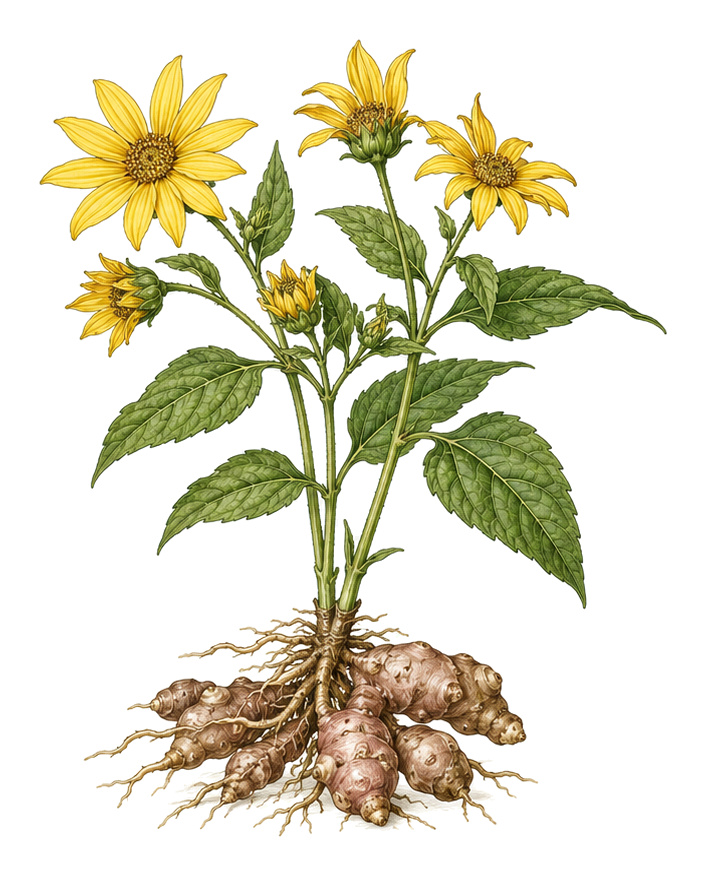
Jerusalem artichokeHelianthus tuberosus

Robust tuber plant with a nutty-sweet flavor, ideal for natural gardens, but prone to spreading.
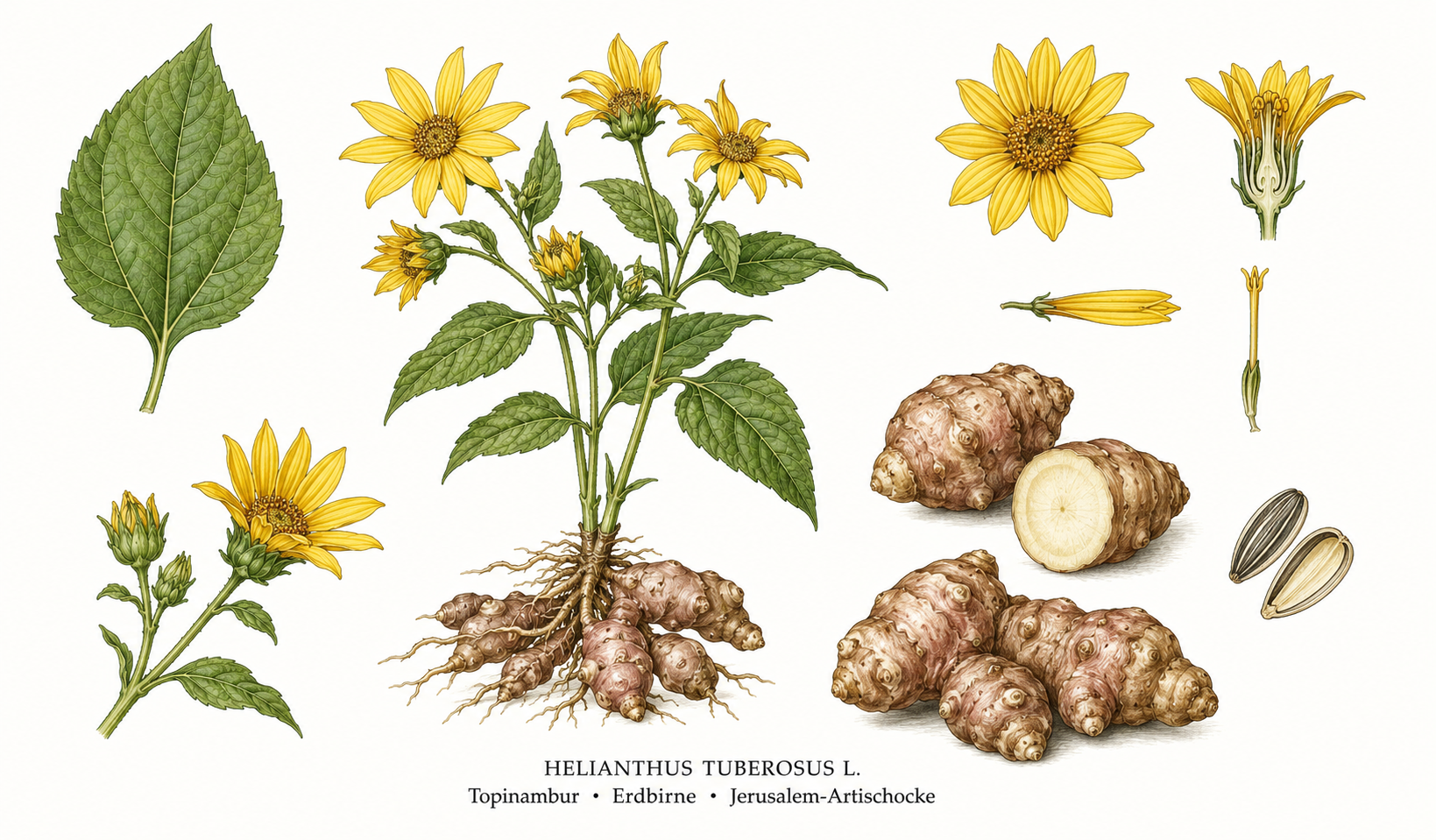
Jerusalem artichoke (Helianthus tuberosus): plant portrait for plant portrait - Vegetables, Aster family, Harvest January
Jerusalem artichoke: plant portrait. harvest: January - March, October - December.

Quick profile

Key data

Harvest

January - March, October - December

Water

medium

Good neighbors

Comfrey

Avoid

potatotomatoLettuce

Growing data

Jerusalem artichoke Growing data

Plant spacing

30 - 50 cm

Row spacing

60 - 100 cm

Sowing and germination

Light germinatorNo
Dark germinatorNo
Cold germinatorNo
Stratification neededNo
Pre-soaking recommendedNo
Direct sowing possibleNo
Pre-culture recommendedNo

Planting and spacing

Plant spacing30 - 50 cm
Row spacing60 - 100 cm
Plants per m²2 - 4 per m²
Bed widthfrom 60 cm
Spacing1 per square foot

Temperature and site

Soil temperature5 - 10 °C
Growing temperaturefrom 5 °C
Optimal temperature18 - 25 °C
Frost sensitiveNo
Late frost sensitiveNo
Heat tolerancehigh
Cold tolerancevery_high

Water, nutrients and care

Watermedium
Critical water phasesDuring tuber formation (July-September)
Watering methodground_level
Droughtmedium
Waterlogging sensitiveYes
Mulching recommendedYes
Nutrient needheavy_feeder
Compost recommendedYes
Fertilizer sensitivitymedium

Container, support and growth

Container suitableNo
SupportYes; 150 - 250 cm
Height150 - 300 cm
Width50 - 100 cm
Root depth15 - 30 cm
Root spread50 - 100 cm
Yield0.5 - 2 kg

Year plan

Jerusalem artichoke Calendar

All plants
Indoor sowingDirect sowingPlantingHarvest

Indoor sowing

No data

Jerusalem artichoke is typically not pre-cultured from seeds but planted directly outdoors from tubers.

Direct sowing

March - April

Plant tubers outdoors as soon as the soil is workable and severe frosts are no longer expected.

Planting

No data

Not applicable, as Jerusalem artichoke is planted directly as a tuber.

Harvest

January - MarchOctober - December

Harvest tubers after the first frost until new growth begins in spring. Tubers can remain in the ground over winter and be harvested as needed.

Year plan
  1. Harvest tubers
  2. Harvest tubers
  3. Plant tubers
  4. Harvest tubers
  5. Plant tubers
  6. Weed
  7. Weed
  8. Water
  9. Water
  10. Support plants
  11. Water
  12. Support plants
  13. Water
  14. Support plants
  15. Water
  16. Harvest tubers
  17. Cut back stalks
  18. Harvest tubers

Growing

Jerusalem artichoke Site, soil and care

Spacing

30 - 50 cm

Storage

Storage method: Best left in the ground and harvested as needed. Alternatively, store in moist sand or sawdust in a cool, dark place (root cellar) or in the refrigerator., Notes: Jerusalem artichoke tubers have a thin skin and dry out quickly. Storing them in the ground is the best method to maintain their freshness.

Pruning

Jerusalem artichoke Pruning

cut_back_dead_foliage

Goal

cut_back_dead_foliage

Pruning timing

Autumn to winter

January - MarchOctober - December

Removal of dead plant parts, preparation for harvest Cutback occurs once aerial parts have died back after the first frost. This can also be done gradually over winter to facilitate harvesting.

Remove

Dead stalks

Preserve

Tubers in the ground for regrowth

Avoid

  • Damaging tubers during cutback
  • Cutting back before aerial parts die (important for tuber maturation)

Tools and hygiene

Use clean, sharp secateurs to ensure clean cuts and minimize disease transmission.

Companion guide

Jerusalem artichoke Companion guide

Companion guide

Good neighbors

Comfrey

Avoid

potatotomatoLettuce

Health

Pests, Diseases

FAQ

How do you plant Jerusalem artichoke correctly?

Jerusalem artichoke tubers are planted directly into the ground in March or April. Maintain a planting distance of 30-50 cm within rows and 60-100 cm between rows. A planting depth of 8-15 cm is ideal. A root barrier is recommended to control its spread.

When is the best harvest time for Jerusalem artichoke?

The harvest season for Jerusalem artichoke begins after the first frost in October and can continue until new growth in March, as long as the ground is not frozen. The first frost improves the flavor of the tubers.

What is the best way to store Jerusalem artichoke?

It's best to leave the tubers in the ground and harvest them fresh as needed. Alternatively, they can be stored in moist sand or sawdust in a cool, dark place (e.g., root cellar) for 2-4 weeks. In the refrigerator, they last about 1-2 weeks.

Is Jerusalem artichoke invasive and how can its spread be controlled?

Yes, Jerusalem artichoke can spread very vigorously via its tubers and become invasive. To prevent this, planting with a root barrier (e.g., pond liner or metal sheet) or in a confined bed is essential.

Why does Jerusalem artichoke cause flatulence?

Jerusalem artichoke is rich in inulin, a dietary fiber that is not digested in the human gut but fermented by bacteria. This can cause flatulence and digestive discomfort in sensitive individuals, especially when consumed raw or in large quantities.

Related plants

Sunflower

Same family

Both belong to the genus Helianthus in the Asteraceae family.

Yacón

Same family

Also an Asteraceae with edible tubers, similar in use.

potato

Same crop groupSimilar nutrient needsSimilar water needs

Both are tuber crops and are grown as root vegetables.

Both are heavy feeders and require good nutrient supply.

Sweet Potato

Same crop group

Also a root vegetable with edible tubers.

Powdery Mildew

Shared diseases

Can occur with dense planting and unfavorable weather conditions.

Sclerotinia Rot

Shared diseases

Can occur in moist, heavy soils and with tuber injuries.

Sources

Public sources

  1. Wikidata entity

    Wikidata · 2026-05-15

  2. GBIF species match

    GBIF · 2026-05-15

  3. Deutschsprachige Wikipedia: Topinambur

    Wikipedia · 2026-05-15

  4. English Wikipedia: Jerusalem artichoke

    Wikipedia · 2026-05-15

Details

More public plant data

Names
Common

Jerusalem artichoke

Plural

Jerusalem artichokes

BotanicalHelianthus tuberosus
Botanical authorL.
Scientific synonyms
  1. Helianthus pubescens
  2. Helianthus esculentus
  3. Helianthus doronicoides
  4. Helianthemum tuberosum
  5. Helianthus tuberosus f. moldenkeanus
  6. Helianthus subcanescens
  7. Helianthus tuberosus var. multituberculatus
  8. Helianthus tuberosus var. nebrascensis
  9. Helianthus tuberosus var. typicus
  10. Helianthus tuberosus var. albus
  11. Helianthus tuberosus var. alexandri
  12. Helianthus strumosus subsp. tomentosus
  13. Helianthus tuberosus var. fusiformis
  14. Helianthus tuberosus var. purpurellus
  15. Helianthus tuberosus f. oswaldiae
  16. Helianthus tomentosus
  17. Helianthus tuberosus var. subcanescens
  18. Helianthus tuberosus var. purpureus
  19. Helianthus serotinus
  20. Helianthus spathulatus
Synonyms
  1. sunroot
  2. sunchoke
  3. earth apple
  4. lambchoke
  5. topinambur
  6. topinambour
  7. Canadian sunflower
  8. Jerusalem artichoke
Common synonyms
  1. sunroot
  2. sunchoke
  3. earth apple
  4. lambchoke
  5. topinambur
  6. topinambour
  7. Canadian sunflower
  8. Jerusalem artichoke
Regional names
Historical names
Market names
Misspellings
International names
Fr
  1. topinambour
Es
  1. tupinambo
It
  1. topinambur
Pl
  1. słonecznik bulwiasty
Search terms
  1. Jerusalem artichoke
  2. sunroot
  3. sunchoke
  4. earth apple
  5. lambchoke
  6. topinambur
  7. topinambour
  8. Canadian sunflower
  9. Helianthus tuberosus
Taxonomy
KingdomPlantae
Clades
  1. Angiosperms
  2. Eudicots
  3. Asterids
OrderAsterales
Family botanicalAsteraceae
Family

Aster family

Family idasteraceae
SubfamilyAsteroideae
TribeHeliantheae
GenusHelianthus
Speciestuberosus
Hybrid statusnot_hybrid
Related crops
  1. Helianthus annuus
Classification
Main groupVegetable
Sub groupRoot Vegetable
Crop groupTuber Crop
Life cyclePerennial
Perennialyes
Woodyno
Treeno
Shrubno
Edible parts
  1. Tubers
  2. Root
Calendar
Sowing indoor
Notes

Jerusalem artichoke is typically not pre-cultured from seeds but planted directly outdoors from tubers.

Sowing outdoor
Months
  1. 3
  2. 4
Earliest month3
Latest month4
Notes

Plant tubers outdoors as soon as the soil is workable and severe frosts are no longer expected.

Planting out
Notes

Not applicable, as Jerusalem artichoke is planted directly as a tuber.

Harvest
Months
  1. 10
  2. 11
  3. 12
  4. 1
  5. 2
  6. 3
Earliest month10
Latest month3
Notes

Harvest tubers after the first frost until new growth begins in spring. Tubers can remain in the ground over winter and be harvested as needed.

Month tasks
1
  1. Harvest tubers if the ground is not frozen.

2
  1. Harvest tubers if the ground is not frozen.

3
  1. Harvest tubers if the ground is not frozen.

  2. Plant tubers.

4
  1. Plant tubers.

  2. Protect young plants from weeds.

5
  1. Water regularly, especially during dry periods.

  2. Weed regularly.

6
  1. Water regularly.

  2. Provide support if needed.

7
  1. Water regularly, especially during tuber formation.

  2. Provide support if needed.

8
  1. Water regularly.

  2. Provide support if needed.

9
  1. Water regularly until leaves yellow.

  2. Check supports.

10
  1. Harvest first tubers after the first frost.

  2. Cut back stalks once they have died back.

11
  1. Harvest tubers as long as the ground is not frozen.

12
  1. Harvest tubers if the ground is not frozen.

Structured month tasks
1
  1. Taskharvest_tubers
    Label

    Harvest tubers

    Prioritymedium
    Months
    1. 1
    ConditionBoden frostfrei
    Estimated effortmedium
    Notes

    Jerusalem artichoke tubers can remain in the ground all winter and be harvested as needed, as long as the soil is not frozen.

2
  1. Taskharvest_tubers
    Label

    Harvest tubers

    Prioritymedium
    Months
    1. 2
    ConditionBoden frostfrei
    Estimated effortmedium
    Notes

    Last opportunity to harvest before new growth. Do not harvest all tubers to allow for self-seeding or for next season's planting.

3
  1. Taskplant_tubers
    Label

    Plant tubers

    Priorityhigh
    Months
    1. 3
    ConditionBoden bearbeitbar, kein starker Frost mehr
    Estimated effortmedium
    Notes

    Plant tubers in well-prepared soil. Spacing 30-50 cm in the row, 60-100 cm between rows. Planting depth 8-15 cm.

  2. Taskharvest_tubers
    Label

    Harvest tubers

    Prioritylow
    Months
    1. 3
    ConditionBoden frostfrei, vor Neuaustrieb
    Estimated effortmedium
    Notes

    Final harvest before new plants emerge.

4
  1. Taskplant_tubers
    Label

    Plant tubers

    Prioritymedium
    Months
    1. 4
    ConditionBoden bearbeitbar
    Estimated effortmedium
    Notes

    Late planting of tubers.

  2. Taskweed
    Label

    Weed

    Prioritymedium
    Months
    1. 4
    ConditionJunge Pflanzen sichtbar
    Estimated effortlow
    Notes

    Young Jerusalem artichoke plants are initially sensitive to weed competition.

5
  1. Taskweed
    Label

    Weed

    Prioritymedium
    Months
    1. 5
    ConditionRegelmäßig
    Estimated effortlow
    Notes

    Regular weeding promotes Jerusalem artichoke growth.

  2. Taskwater
    Label

    Water

    Prioritymedium
    Months
    1. 5
    ConditionBei Trockenheit
    Estimated effortlow
    Notes

    Ensure adequate water supply, especially during dry weather.

6
  1. Taskwater
    Label

    Water

    Prioritymedium
    Months
    1. 6
    ConditionBei Trockenheit
    Estimated effortlow
    Notes

    Important for vigorous growth.

  2. Tasksupport_plants
    Label

    Support plants

    Prioritylow
    Months
    1. 6
    ConditionPflanzen erreichen Höhe
    Estimated effortmedium
    Notes

    Tall varieties can be blown over by wind. Stakes or fences provide support.

7
  1. Taskwater
    Label

    Water

    Priorityhigh
    Months
    1. 7
    ConditionWährend der Knollenbildung
    Estimated effortlow
    Notes

    Sufficient water supply is crucial for the development of large tubers.

  2. Tasksupport_plants
    Label

    Support plants

    Prioritymedium
    Months
    1. 7
    ConditionPflanzen wachsen weiter
    Estimated effortmedium
    Notes

    Regularly check the stability of supports.

8
  1. Taskwater
    Label

    Water

    Priorityhigh
    Months
    1. 8
    ConditionWährend der Knollenbildung
    Estimated effortlow
    Notes

    Continued watering is important for tuber development.

  2. Tasksupport_plants
    Label

    Support plants

    Prioritymedium
    Months
    1. 8
    ConditionPflanzen erreichen volle Höhe
    Estimated effortmedium
    Notes

    Good support is essential, especially in windy locations.

9
  1. Taskwater
    Label

    Water

    Prioritymedium
    Months
    1. 9
    ConditionBei Trockenheit, bis Blätter vergilben
    Estimated effortlow
    Notes

    Plants begin to focus on tuber maturation.

10
  1. Taskharvest_tubers
    Label

    Harvest tubers

    Priorityhigh
    Months
    1. 10
    ConditionNach dem ersten Frost
    Estimated effortmedium
    Notes

    The first frost improves the flavor of the tubers. Harvest as needed.

  2. Taskcut_back_stalks
    Label

    Cut back stalks

    Prioritymedium
    Months
    1. 10
    ConditionSobald abgestorben
    Estimated effortmedium
    Notes

    Dead stalks can be used as mulch or removed for easier harvesting.

11
  1. Taskharvest_tubers
    Label

    Harvest tubers

    Priorityhigh
    Months
    1. 11
    ConditionBoden frostfrei
    Estimated effortmedium
    Notes

    Continued harvesting as needed.

12
  1. Taskharvest_tubers
    Label

    Harvest tubers

    Prioritymedium
    Months
    1. 12
    ConditionBoden frostfrei
    Estimated effortmedium
    Notes

    Harvest possible during mild weather.

Cultivation specs
Seed
Light germinatorno
Dark germinatorno
Cold germinatorno
Stratification neededno
Pre soaking recommendedno
Direct sowing possibleno
Pre culture recommendedno
Spacing
Plant spacing cm min.30
Plant spacing cm max.50
Row spacing cm min.60
Row spacing cm max.100
Recommended density per sqm min.2
Recommended density per sqm max.4
Min. bed width60 cm
Square foot gardening spacing1 per square foot
Spacing notes

Jerusalem artichoke spreads vigorously, so adequate spacing or a root barrier is recommended.

Growth dimensions
Height cm min.150
Height cm max.300
Width cm min.50
Width cm max.100
Root depth cm min.15
Root depth cm max.30
Root spread cm min.50
Root spread cm max.100
Growth speedfast
Final size notes

Jerusalem artichoke can grow very tall and forms a dense canopy. Tubers develop in the upper root zone.

Temperature
Min. growing temperature5 °C
Optimal temperature c min.18
Optimal temperature c max.25
Max. heat tolerance35 °C
Soil temperature for sowing c min.5
Soil temperature for sowing c optimal10
Frost sensitiveno
Late frost sensitiveno
Heat tolerancehigh
Cold tolerancevery_high
Temperature notes

The plant is extremely frost-hardy. Tubers overwinter easily in the ground and can be harvested even after frost, once the soil thaws. A light frost before harvest improves the flavor of the tubers.

Water
Water needmedium
Critical water phases
  1. During tuber formation (July-September)
Drought tolerantyes
Drought sensitivitymedium
Waterlogging sensitiveyes
Mulching recommendedyes
Water notes

While Jerusalem artichoke tolerates some drought, consistent watering, especially during tuber development, is important for good yields. Avoid waterlogging.

Nutrition
Nutrient groupheavy_feeder
Heavy feederyes
Medium feederno
Light feederno
Nitrogen needhigh
Phosphorus needmedium
Potassium needhigh
Calcium needmedium
Magnesium needmedium
Compost recommendedyes
Mulching recommendedyes
Fertilizer sensitivitymedium
Nutrition notes

Jerusalem artichoke is a heavy feeder and benefits from good nutrient supply, especially with compost or organic fertilizer before planting. A mulch layer helps retain moisture and slowly release nutrients.

Container
Container suitableno
Drainage requiredno
Repotting neededno
Container notes

Due to its size and spreading habit, Jerusalem artichoke is only marginally suitable for container cultivation and requires very large pots.

Support
Needs supportyes
Support recommendedyes
Climbingno
Viningno
Trellis recommendedno
Support types
  1. stake
  2. natural_support
Support height cm min.150
Support height cm max.250
Training requiredno
Support notes

The tall stalks can easily break in strong winds. Support with individual stakes or a row of plants growing along a wire is recommended.

Cultivation modes
Outdoor bed suitableyes
Raised bed suitableyes
Container suitableno
Balcony suitableno
Greenhouse suitableno
Polytunnel suitableno
Indoor suitableno
Windowsill suitableno
Hydroponic possibleno
Permaculture suitableyes
No dig suitableyes
Yield density
Yield per plant min.0.5
Yield per plant max.2
Yield unitkg
Yield per sqm min.1
Yield per sqm max.4
Yield reliabilityhigh
Yield notes

Yield can vary greatly depending on variety, location, and care. Jerusalem artichoke is very productive and forms many tubers.

Site
Sunlight exposurefull sun
Wind exposuresheltered_to_moderate
Site notes

Jerusalem artichoke prefers a sunny location but also tolerates partial shade. A sheltered spot is advantageous due to its height, to prevent stalks from breaking in wind.

Soil
Soil type
  1. Deep
  2. Humus-rich
  3. Sandy loam
PH min.6
PH max.7.5
Drainagewell drained
Soil notes

Jerusalem artichoke is undemanding but prefers deep, humus-rich, and well-drained soil. Waterlogging must be avoided, as it can lead to tuber rot.

Watering
Water needmedium
Watering frequency

Regularly, especially during dry spells and tuber formation.

Drought tolerantyes
Waterlogging sensitiveyes
Mulching recommendedyes
Watering notes

A layer of mulch helps retain soil moisture and reduce watering efforts.

Nutrition
Nutrient groupheavy_feeder
Fertilizer application

Incorporate plenty of compost or well-rotted manure before planting. During the growing season, an additional application of organic liquid fertilizer can be beneficial.

Compost recommendedyes
Mulching recommendedyes
Nutrition notes

As a heavy feeder, Jerusalem artichoke requires good nutrient supply to achieve high yields. Balanced fertilization promotes tuber development.

Cultivation planning
Succession sowing
Possibleno
Bed planning notes

Jerusalem artichoke spreads vigorously via its tubers and can become invasive. A root barrier or a dedicated, confined area is recommended to control its spread. Avoid planting in beds where other crops should not be overgrown.

Rotation priorityhigh
Interplanting potentiallow
Mechanization relevancelow
Crop rotation
  1. As a perennial plant, Jerusalem artichoke typically remains in the same location for several years, so traditional crop rotation is not applicable.
  2. When establishing a new bed after Jerusalem artichoke, the soil should be thoroughly cleared of tuber remnants to prevent regrowth. A cultivation break of 3-4 years for Asteraceae is advisable if the area is to be used for other crops.
Deficiencies
  1. Jerusalem artichoke is a robust plant and rarely shows specific deficiency symptoms if the soil is adequately supplied with nutrients. In very poor soils, general growth disorders may occur.
Problems
  1. Uncontrolled spread via tubers
  2. Heavy shading of neighboring crops due to its height
  3. Tuber rot in waterlogged conditions
Problem management
Common pest groups
  1. Voles and mice
  2. Slugs
Common disease groups
  1. Fungal diseases (e.g., Powdery Mildew, Sclerotinia Rot)
Prevention principles
  1. Install root barriers to prevent uncontrolled spread.
  2. Ensure good soil drainage to avoid tuber rot.
  3. Maintain sufficient plant spacing for good air circulation.
  4. Implement protective measures against voles (e.g., wire planting baskets).
Diagnosis notes

Look for feeding damage on tubers (voles) or young shoots (slugs). Leaf discoloration or coatings indicate diseases or nutrient deficiencies. Soft, rotten tubers point to waterlogging or rot.

Disease graph
Scopecommon_temperate_europe
Profiles
  1. Slugslugs
    Severitylow_to_medium
    Conditions
    1. Humid weather
    2. Young shoots
    Affected parts
    1. Young leaves
    2. Stems
    Prevention
    1. Garden hygiene
    2. Mulch layer not too thick around young plants
    3. Slug collars
    Organic control
    1. Hand-picking
    2. Slug traps
    3. Iron phosphate pellets
  2. Slugrodents_voles_mice
    Severityhigh
    Conditions
    1. Presence of rodents
    2. Light, loose soils
    Affected parts
    1. Tubers
    Prevention
    1. Wire planting baskets
    2. Deep planting
    3. Encourage natural predators
    Organic control
    1. Vole traps
    2. Repellent plants (e.g., Crown Imperial)
  3. Slugpowdery_mildew
    Severitylow
    Conditions
    1. Drought followed by humidity
    2. Dense stands
    3. Late summer/autumn
    Affected parts
    1. Leaves
    2. Stems
    Prevention
    1. Sufficient plant spacing
    2. Good air circulation
    3. Choose robust varieties
    Organic control
    1. Remove affected leaves
    2. Spray milk-water mixture
    3. Horsetail decoction
  4. Slugsclerotinia_rot
    Severitymedium
    Conditions
    1. Moist, heavy soils
    2. High humidity
    3. Injuries to tubers/stems
    Affected parts
    1. Tubers
    2. Stem base
    Prevention
    1. Good soil drainage
    2. Avoid waterlogging
    3. Plant spacing
    4. Crop rotation (if applicable)
    Organic control
    1. Remove and destroy infected plants and tubers
    2. Soil hygiene
Diagnostic rules
  1. Symptom

    Feeding damage on tubers

    Possible causes
    1. rodents_voles_mice
    First checks
    1. Look for vole tunnels
    2. Set traps
  2. Symptom

    Feeding damage on young shoots/leaves

    Possible causes
    1. slugs
    First checks
    1. Look for slugs at night
    2. Set slug traps
  3. Symptom

    White, powdery coating on leaves

    Possible causes
    1. powdery_mildew
    First checks
    1. Check air circulation
    2. Assess plant density
  4. Symptom

    Soft, rotten tubers or stem base

    Possible causes
    1. sclerotinia_rot
    2. waterlogging
    First checks
    1. Check soil moisture and drainage
    2. Remove plant debris
Prevention strategy
Cultural
  1. Install root barriers to prevent uncontrolled spread.
  2. Ensure sufficient plant spacing for good air circulation.
  3. Provide good soil drainage to avoid waterlogging.
  4. Incorporate organic matter (compost) before planting to promote soil health.
Monitoring
  1. Regularly check for feeding damage on young shoots and tubers.
  2. Inspect leaves for coatings or discoloration, especially in late summer.
  3. Look for signs of voles (tunnels, mounds of earth).
Organic first response
  1. Hand-pick slugs or set traps.
  2. Remove mildew-affected leaves and spray with a milk-water mixture.
  3. Deploy vole traps.
  4. In case of rot, remove affected plant parts and improve soil hygiene.
Notes

Jerusalem artichoke is a robust plant rarely affected by severe diseases or pests. The biggest challenge is controlling its spread and protecting against voles.

Phenology
Stages
  1. Tuber planting (March-April)
  2. Vegetative growth (May-August)
  3. Flowering (September-October)
  4. Tuber formation and maturation (July-November)
  5. Harvest/Winter dormancy (October-March)
Notes

Jerusalem artichoke is a perennial plant whose tubers overwinter in the ground and sprout anew in spring. The aerial parts die back in autumn after the first frost.

Flowering pollination
Flowering period

Late summer to autumn (September-October)

Flower description

Sunflower-like, yellow flower heads on tall stalks.

Notes

Flowering occurs relatively late in the year, often just before the first frost. The flowers are a good food source for late-season insects.

Harvest
Harvest period

October to March (after the first frost until new growth)

Harvest method

Carefully lift tubers from the ground with a digging fork. Do not harvest all tubers to allow for self-seeding for the next year.

Notes

The flavor of the tubers improves after the first frost. They can remain in the ground all winter and be harvested as needed, as long as the ground is not frozen.

Harvest details
Harvest frequency

Continuously as needed from autumn to spring, as long as the ground is not frozen.

Harvest indicators
  1. Dieback of aerial plant parts after the first frost
  2. Tubers have reached a firm consistency
Post harvest handling

Gently brush off soil from tubers, but do not wash if they are to be stored. They dry out quickly and should be processed or stored promptly.

Storage
Storage method

Best left in the ground and harvested as needed. Alternatively, store in moist sand or sawdust in a cool, dark place (root cellar) or in the refrigerator.

Notes

Jerusalem artichoke tubers have a thin skin and dry out quickly. Storing them in the ground is the best method to maintain their freshness.

Storage details
General storage category

Root vegetable (in-ground / cool and moist)

Storage life

In-ground: several months (all winter); Cool and moist: 2-4 weeks; Refrigerator: 1-2 weeks; Room temperature: a few days.

Processing options
  1. Freezing (blanched)
  2. Pickling
  3. Drying (chips)
  4. Pureeing
Processing use
Preparation methods
  1. Peeling (often difficult due to irregular shape)
  2. Scrubbing (if skin is eaten)
  3. Boiling
  4. Steaming
  5. Roasting
  6. Frying
  7. Pureeing
  8. Raw in salads
Notes

To prevent peeled tubers from browning, place them immediately in lemon water.

Kitchen usage
Culinary uses
  1. Soups and cream soups
  2. Purees (often mixed with potatoes)
  3. Roasted vegetables
  4. Chips (thinly sliced and fried or baked)
  5. Salads (raw, finely shaved)
  6. Side dish for meat and fish
  7. Stir-fries
Flavor profile

Nutty, slightly sweet, earthy, reminiscent of artichoke hearts or salsify.

Notes

Jerusalem artichoke is rich in inulin, which gives it a slightly sweet note and makes it interesting for diabetics. However, inulin can cause flatulence in some people.

Safety and edibility
Edible parts
  1. Tubers (stem tubers)
Inedible or caution parts
  1. Leaves and stems (not suitable for consumption)
Toxicity notes

The plant is not toxic. The high inulin content of the tubers can cause flatulence and digestive discomfort in sensitive individuals, especially when consumed raw or in large quantities.

Raw consumption

Yes, in moderation. Finely sliced or grated in salads. For sensitive stomachs, raw consumption should be limited.

Seed saving
Feasibility

Not common for home gardens. Jerusalem artichoke is primarily propagated vegetatively via tubers.

Notes

Although Jerusalem artichoke produces seeds, they are often not true-to-type, and germination rates can vary. Propagation via tubers is simpler and more reliable.

Seed saving advanced
Pollination type

Cross-pollinated (by insects)

Isolation requirements

For true-to-type seeds, an isolation distance of at least 800 meters from other Jerusalem artichoke varieties or wild forms is required. Alternatively, hand-pollination or isolation with insect netting can be used.

Seed maturation indicators

Seeds mature in the flower heads after blooming. The bracts turn brown and dry.

Seed processing

Allow flower heads to dry, then extract seeds and separate from chaff.

Seed storage

Store dry, cool, and dark. Seeds require cold stratification for germination.

Notes

Germination of Jerusalem artichoke seeds can be irregular and requires patience. Most gardeners prefer vegetative propagation.

Woody crop details
Rootstock relevancenot_applicable
Renewal pruning relevancenot_applicable
Notes

Jerusalem artichoke is a herbaceous plant and does not require specific woody training systems or rootstocks.

Ecology
Pollinator valuehigh
Wildlife valuemedium
Biodiversity notes

The late flowering of Jerusalem artichoke in autumn provides an important food source for bees and other insects when other flowering plants have already faded. The tubers in the ground serve as winter food for voles and other rodents, which can be undesirable in gardens.