Profile

Mirabelle plumPrunus domestica subsp. syriaca

The Mirabelle plum is a sweet, golden-yellow stone fruit popular for fresh eating, jams, and cakes. It is robust and easy to care for, but requires a sunny location and regular pruning.
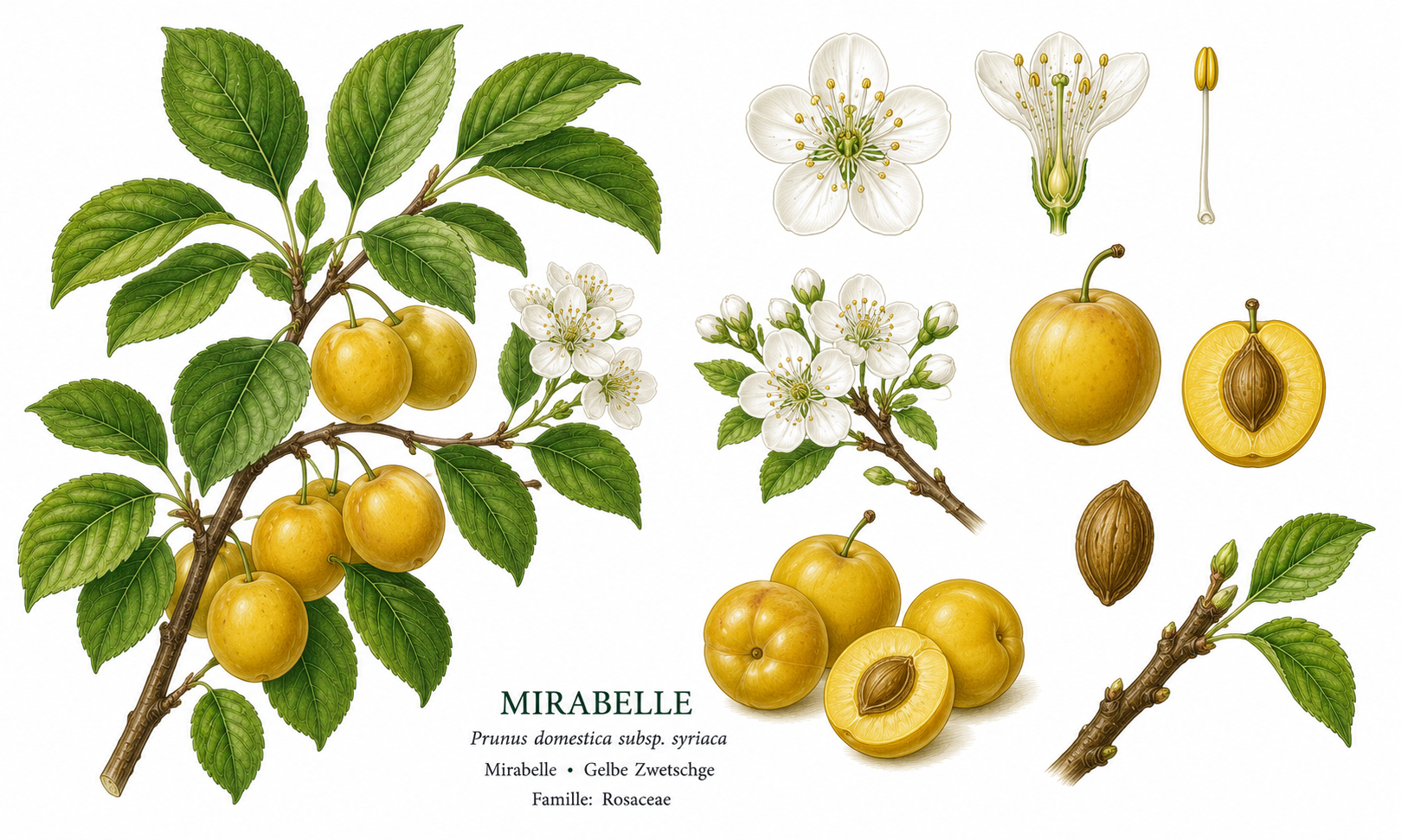
Mirabelle plum (Prunus domestica subsp. syriaca): plant portrait for plant portrait - Fruit, Rose family, Harvest Jul, Aug
Mirabelle plum: plant portrait. harvest: Jul, Aug.

Quick profile

Key data

Planting

Mar, Apr, Oct, Nov

Harvest

Jul, Aug

Water

medium

Good neighbors

LupineComfreyBorageMarigold

Avoid

Walnut treeRaspberry

Growing data

Mirabelle plum Growing data

Seed depth

2 - 3 cm

Plant spacing

300 - 500 cm

Row spacing

300 - 500 cm

Germination temp

15 - 20 °C

Sowing and germination

Seed depth2 - 3 cm
Germination temp15 - 20 °C
Germination time30 - 90 days
Seed viability1 - 2 years
Light germinatorNo
Dark germinatorYes
Cold germinatorYes
Stratification neededYes
Pre-soaking recommendedNo
Direct sowing possibleYes
Pre-culture recommendedNo

Planting and spacing

Plant spacing300 - 500 cm
Row spacing300 - 500 cm
Plants per m²0.04 - 0.1 per m²

Temperature and site

Soil temperature8 - 12 °C
Growing temperaturefrom 5 °C
Optimal temperature15 - 25 °C
Frost sensitiveNo
Late frost sensitiveYes
Heat tolerancemedium
Cold tolerancehigh

Water, nutrients and care

Watermedium
Critical water phasesFlowering, Fruit set, Fruit development
Watering methoddrip_irrigation
Droughtmedium
Waterlogging sensitiveYes
Mulching recommendedYes
Nutrient needmedium_feeder
Compost recommendedYes
Fertilizer sensitivitymedium

Container, support and growth

Container suitableNo
Pot sizeVolume: from 50 l; Recommended: from 100 l; Diameter: from 50 cm; Depth: from 50 cm
SupportYes; 150 - 200 cm
Height300 - 600 cm
Width200 - 400 cm
Root depth50 - 150 cm
Root spread200 - 400 cm
Yield10 - 30 kg

Year plan

Mirabelle plum Calendar

All plants
Indoor sowingDirect sowingPlantingHarvest

Indoor sowing

No data

Mirabelle plums are generally not sown indoors but planted as grafted young trees.

Direct sowing

SepOctNov

Sowing pits outdoors in autumn for natural stratification. Note that trees grown from pits may not be true to type.

Planting

MarAprOctNov

Planting young trees in spring or autumn. Autumn planting is often preferred to allow the tree to establish before winter.

Harvest

JulAug

Harvest time varies by variety and climate, but typically begins in mid-summer.

Year plan
  1. Check for winter damage and pests
  2. Winter pruning if necessary
  3. Continue winter pruning
  4. Check for pests and diseases
  5. Planting new trees
  6. First fertilization
  7. Blossom frost protection
  8. Monitor for blossom blight
  9. Fruit thinning
  10. Regular watering
  11. Regular watering
  12. Monitor for pests and diseases
  13. Start of harvest
  14. Regular watering
  15. Main harvest
  16. Summer pruning after harvest
  17. Post-harvest care
  18. Preparation for autumn plantings

Growing

Mirabelle plum Site, soil and care

Spacing

300 - 500 cm

Storage

Storage conditions: Cool and airy, Storage temperature c: Min: 0, Max: 5, Storage humidity percent: Min: 85, Max: 90

Pruning

Mirabelle plum Pruning

Mirabelle plums tend to grow vigorously and can quickly become unproductive without pruning. Regular, but not overly radical, pruning is important.

Goal

Obstbaumschnitt (Erziehungs- und Erhaltungsschnitt)

Notes

Mirabelle plums tend to grow vigorously and can quickly become unproductive without pruning. Regular, but not overly radical, pruning is important.

Pruning timing

winter

JanFebMar

Training pruning, thinning pruning, corrective pruning Perform on frost-free days to promote wound healing and avoid gummosis. Complete before bud break.

summer

Aug

Light thinning, removal of water shoots, promotion of fruit wood formation Perform after harvest. Reduces vigor and promotes the formation of flower buds for the next year.

Remove

  • Dead wood and diseased branches
  • Inward-growing or crossing branches
  • Water shoots (steep, vigorous shoots without fruit wood)
  • Old, unproductive fruit wood (over 4 years old)
  • Competing shoots to scaffold branches

Preserve

  • Young, well-positioned fruit spurs (1-4 years old)
  • Stable scaffold branches that form the crown structure
  • Sufficient light and air within the crown

Avoid

  • Heavy pruning during frost or immediately before bud break (risk of gummosis)
  • Removal of too much young fruit wood
  • Pruning in wet weather (increased risk of fungal infections)

Tools and hygiene

Always use clean and sharp pruning tools to prevent disease transmission and create smooth wounds. Disinfect tools after cutting diseased branches.

Companion guide

Mirabelle plum Companion guide

Companion guide

Good neighbors

LupineComfreyBorageMarigoldChives

Avoid

Walnut treeRaspberry

Health

Pests, Diseases

Pests

Plum fruit moth

  • Wormy fruits
  • Feeding tunnels in flesh
  • Premature fruit drop

Aphids

  • Curled leaves
  • Sticky honeydew
  • Stunted shoots

Plum sawfly

  • Small boreholes in young fruits
  • Fruits drop prematurely
  • Frass inside the fruit

Diseases

Monilia blossom blight and fruit rot

  • Wilting and dieback of blossoms and young shoots (blossom blight)
  • Brown rot on fruits with concentric mold rings

Plum pox virus (Sharka)

  • Yellowish rings or spots on leaves
  • Deformed, unpalatable fruits with ring-shaped depressions
  • Premature fruit drop

Plum rust

  • Yellowish to rust-brown pustules on the upper leaf surface
  • Underside of leaves with rust-brown spore masses
  • Premature leaf drop

Deficiencies

Iron deficiency

  • Young leaves pale yellow to whitish, veins remain green (interveinal chlorosis)
  • Growth disorders

Potassium deficiency

  • Leaf margins turn yellow, then brown and dry out (leaf margin necrosis)
  • Poor fruit development and quality
  • Reduced winter hardiness

Nitrogen deficiency

  • Leaves pale green to yellowish, especially older leaves
  • Poor shoot growth
  • Small fruits

Plant health

FAQ

When is the best time to plant Mirabelle plums?

In spring (March/April) or autumn (October/November), with autumn planting often preferred to allow the tree to establish before winter.

Do I need to prune Mirabelle plum trees?

Yes, regular training and maintenance pruning is important for good crown development, health, and stable yields. Without pruning, Mirabelle plum trees can quickly become unproductive.

Are Mirabelle plums self-fertile?

Most Mirabelle plum varieties are self-fertile, meaning they do not require a second variety for pollination. However, cross-pollination by other Mirabelle or plum varieties can improve yield and fruit quality.

What to do about wormy Mirabelle plums?

Wormy Mirabelle plums often indicate an infestation by the plum fruit moth. Collect and dispose of infested fallen fruit daily. Pheromone traps can be used for monitoring and mass trapping.

Related plants

Apple

Same familySimilar nutrient needs

Belongs to the rose family (Rosaceae)

Both are medium feeders

Cherry

Same familySame crop groupShared diseasesSimilar water needs

Belongs to the rose family (Rosaceae)

Both are stone fruit trees

Apricot

Same familySame crop groupShared diseases

Belongs to the rose family (Rosaceae)

Both are stone fruit trees

European Plum

Same crop groupShared diseasesSimilar nutrient needsSimilar water needs

Both are stone fruit trees

Susceptible to Monilia, plum fruit moth, Sharka virus

Sources

Public sources

  1. Wikidata entity

    Wikidata · 2026-05-14

  2. GBIF species match

    GBIF · 2026-05-14

  3. Deutschsprachige Wikipedia: Mirabelle

    Wikipedia · 2026-05-14

  4. English Wikipedia: Mirabelle plum

    Wikipedia · 2026-05-14

Details

More public plant data

Names
Common

Mirabelle plum

Plural

Mirabelle plums

BotanicalPrunus domestica subsp. syriaca
Botanical author(Borkh.) Janch.
Scientific synonyms
  1. Prunus syriaca
  2. Prunus domestica var. cerea
  3. Prunus insititia var. syriaca
Synonyms
  1. mirabelle plum
Common synonyms
  1. mirabelle plum
Regional names
  1. Kriecherl
Historical names
Market names
Misspellings
Ambiguous names
  1. NameMirabelle
    Languagede
    Shared with
    1. Restaurant
    2. Vorname
    Clarification

    Mirabelle is a subspecies of plum, not the restaurant or given name.

  2. NameMirabelle
    Languageen
    Shared with
    1. Restaurant
    2. Given name
    Clarification

    Mirabelle is a subspecies of plum, not the restaurant or given name.

Search terms
  1. Mirabelle plum
  2. Prunus domestica subsp. syriaca
  3. Prunus syriaca
  4. Prunus domestica var. cerea
  5. Prunus insititia var. syriaca
Taxonomy
KingdomPlantae
OrderRosales
Family botanicalRosaceae
Family

Rose family

Family idrosaceae
GenusPrunus
SpeciesPrunus domestica
Subspeciessyriaca
Hybrid statusnot_hybrid
Related crops
  1. Pflaume
  2. Zwetschge
  3. Kirschpflaume
Classification
Main groupObst
Sub groupSteinobst
Crop groupObstbaum
Life cyclePerennial
Perennialyes
Woodyyes
Treeyes
Shrubno
Edible parts
  1. fruit
Calendar
Sowing indoor
Notes

Mirabelle plums are generally not sown indoors but planted as grafted young trees.

Sowing outdoor
Months
  1. 9
  2. 10
  3. 11
Earliest month9
Latest month11
Notes

Sowing pits outdoors in autumn for natural stratification. Note that trees grown from pits may not be true to type.

Planting out
Months
  1. 3
  2. 4
  3. 10
  4. 11
Earliest month3
Latest month11
Notes

Planting young trees in spring or autumn. Autumn planting is often preferred to allow the tree to establish before winter.

Harvest
Months
  1. 7
  2. 8
Earliest month7
Latest month8
Notes

Harvest time varies by variety and climate, but typically begins in mid-summer.

Month tasks
1
  1. Check for winter damage and pests

  2. Winter pruning if necessary (not during severe frost)

2
  1. Continue winter pruning

  2. Check for pests and diseases

3
  1. Planting new trees

  2. First fertilization with compost or organic fertilizer

  3. Monitor for early pest infestation

4
  1. Protect blossoms from late frost if danger exists

  2. Monitor for blossom blight and other diseases

5
  1. Fruit thinning if fruit set is heavy

  2. Regular watering during dry periods

  3. Monitor for pests (e.g., aphids) and diseases

6
  1. Regular watering, especially during fruit development

  2. Monitor for pests and diseases

7
  1. Start of harvest

  2. Regular watering during dry periods

8
  1. Main harvest

  2. Summer pruning after harvest (if needed)

  3. Regular watering during dry periods

9
  1. Post-harvest care

  2. Preparation for autumn plantings

10
  1. Autumn planting

  2. Remove leaves and mulch around the tree base

11
  1. Winter protection for young trees

  2. Check tree stakes and ties

12
  1. Planning for the next gardening year

  2. Check for winter damage

Month tasks structured
1
  1. Taskpest_disease_control
    Label

    Check for winter damage and pests

    Prioritymedium
    Months
    1. 1
    Conditionfrost_free_days
    Estimated effortlow
    Notes

    Pay special attention to bark cracks and overwintering pests.

  2. Taskpruning
    Label

    Winter pruning if necessary

    Prioritymedium
    Months
    1. 1
    2. 2
    Conditionno_severe_frost
    Estimated effortmedium
    Notes

    Perform only on frost-free days to avoid damage.

2
  1. Taskpruning
    Label

    Continue winter pruning

    Prioritymedium
    Months
    1. 2
    Conditionno_severe_frost
    Estimated effortmedium
    Notes

    Shape and thinning cuts.

  2. Taskpest_disease_control
    Label

    Check for pests and diseases

    Prioritylow
    Months
    1. 2
    Conditionregular
    Estimated effortlow
    Notes

    Pay attention to egg masses and fungal infections.

3
  1. Taskplanting
    Label

    Planting new trees

    Priorityhigh
    Months
    1. 3
    2. 4
    Conditionsoil_workable
    Estimated efforthigh
    Notes

    Water roots well and firm the tree in.

  2. Taskfertilizing
    Label

    First fertilization

    Prioritymedium
    Months
    1. 3
    Conditionbefore_bud_break
    Estimated effortmedium
    Notes

    Incorporate compost or organic complete fertilizer.

  3. Taskpest_disease_control
    Label

    Monitor for early pest infestation

    Prioritymedium
    Months
    1. 3
    Conditionregular
    Estimated effortlow
    Notes

    Pay special attention to aphids on young shoots.

4
  1. Taskfrost_protection
    Label

    Blossom frost protection

    Priorityhigh
    Months
    1. 4
    Conditionlate_frost_forecast
    Estimated effortmedium
    Notes

    Cover with fleece or irrigate.

  2. Taskpest_disease_control
    Label

    Monitor for blossom blight

    Prioritymedium
    Months
    1. 4
    Conditionwet_weather_during_flowering
    Estimated effortlow
    Notes

    Remove infected blossoms and shoots.

5
  1. Taskthinning
    Label

    Fruit thinning

    Prioritymedium
    Months
    1. 5
    Conditionheavy_fruit_set
    Estimated effortmedium
    Notes

    For larger fruits and to relieve stress on the tree.

  2. Taskwatering
    Label

    Regular watering

    Prioritymedium
    Months
    1. 5
    2. 6
    3. 7
    4. 8
    Conditiondry_periods
    Estimated effortlow
    Notes

    Especially important during fruit development.

  3. Taskpest_disease_control
    Label

    Monitor for pests and diseases

    Prioritymedium
    Months
    1. 5
    2. 6
    Conditionregular
    Estimated effortlow
    Notes

    Watch for aphids, spider mites, and fungal diseases.

6
  1. Taskwatering
    Label

    Regular watering

    Prioritymedium
    Months
    1. 6
    Conditiondry_periods
    Estimated effortlow
    Notes

    Ensure fruits receive sufficient water.

  2. Taskpest_disease_control
    Label

    Monitor for pests and diseases

    Prioritymedium
    Months
    1. 6
    Conditionregular
    Estimated effortlow
    Notes

    Pay special attention to fruit rot in humid weather.

7
  1. Taskharvest
    Label

    Start of harvest

    Priorityhigh
    Months
    1. 7
    Conditionfruits_ripe
    Estimated effortmedium
    Notes

    Fruits are ripe when soft and easily detached from the stem.

  2. Taskwatering
    Label

    Regular watering

    Prioritymedium
    Months
    1. 7
    Conditiondry_periods
    Estimated effortlow
    Notes

    Supports fruit development and quality.

8
  1. Taskharvest
    Label

    Main harvest

    Priorityhigh
    Months
    1. 8
    Conditionfruits_ripe
    Estimated efforthigh
    Notes

    Harvest regularly to prevent overripening and fruit drop.

  2. Taskpruning
    Label

    Summer pruning after harvest

    Prioritylow
    Months
    1. 8
    Conditionafter_harvest
    Estimated effortmedium
    Notes

    To promote fruit wood formation and thinning.

  3. Taskwatering
    Label

    Regular watering

    Prioritymedium
    Months
    1. 8
    Conditiondry_periods
    Estimated effortlow
    Notes

    Important for tree regeneration after harvest.

9
  1. Taskpost_harvest_care
    Label

    Post-harvest care

    Prioritymedium
    Months
    1. 9
    Conditionafter_harvest
    Estimated effortlow
    Notes

    Mulch around the tree base and water if necessary.

  2. Taskplanting_preparation
    Label

    Preparation for autumn plantings

    Prioritymedium
    Months
    1. 9
    Conditionplanning_new_trees
    Estimated effortmedium
    Notes

    Prepare planting holes and improve soil.

10
  1. Taskplanting
    Label

    Autumn planting

    Priorityhigh
    Months
    1. 10
    2. 11
    Conditionsoil_workable
    Estimated efforthigh
    Notes

    Ideal for establishment before winter.

  2. Taskmulching
    Label

    Mulch around the tree base

    Prioritymedium
    Months
    1. 10
    Conditionafter_leaf_fall
    Estimated effortlow
    Notes

    Protects against frost and retains moisture.

11
  1. Taskwinter_protection
    Label

    Winter protection for young trees

    Prioritymedium
    Months
    1. 11
    Conditionbefore_first_frost
    Estimated effortmedium
    Notes

    Protect trunk with jute or reed mats.

  2. Taskmaintenance
    Label

    Check tree stakes

    Prioritylow
    Months
    1. 11
    Conditionregular
    Estimated effortlow
    Notes

    Ensure ties are not cutting into the bark.

12
  1. Taskplanning
    Label

    Garden planning

    Prioritylow
    Months
    1. 12
    Conditionwinter_rest
    Estimated effortlow
    Notes

    Use winter months for planning the next gardening year.

Book content
Introduction

The Mirabelle plum, a golden-yellow delicacy, is a staple in many Central European gardens. Its sweet, aromatic fruits are not only a delight fresh but also versatile in the kitchen.

Cultivation guide

Cultivating Mirabelle plum trees requires a sunny, sheltered location and well-drained soil. Regular pruning and sufficient water supply are crucial for a bountiful harvest.

Harvest storage

Mirabelle plums are harvested in mid-summer when they are golden-yellow and soft. They are delicate and should be processed or cooled quickly.

Pests diseases

Common problems include plum fruit moth and Monilia. Preventive measures such as hygiene and promoting beneficial insects are important.

Structured month tasks
1
  1. Taskpest_disease_control
    Label

    Check for winter damage and pests

    Prioritymedium
    Months
    1. 1
    Conditionfrost_free_days
    Estimated effortlow
    Notes

    Pay special attention to bark cracks and overwintering pests.

  2. Taskpruning
    Label

    Winter pruning if necessary

    Prioritymedium
    Months
    1. 1
    2. 2
    Conditionno_severe_frost
    Estimated effortmedium
    Notes

    Perform only on frost-free days to avoid damage.

2
  1. Taskpruning
    Label

    Continue winter pruning

    Prioritymedium
    Months
    1. 2
    Conditionno_severe_frost
    Estimated effortmedium
    Notes

    Shape and thinning cuts.

  2. Taskpest_disease_control
    Label

    Check for pests and diseases

    Prioritylow
    Months
    1. 2
    Conditionregular
    Estimated effortlow
    Notes

    Pay attention to egg masses and fungal infections.

3
  1. Taskplanting
    Label

    Planting new trees

    Priorityhigh
    Months
    1. 3
    2. 4
    Conditionsoil_workable
    Estimated efforthigh
    Notes

    Water roots well and firm the tree in.

  2. Taskfertilizing
    Label

    First fertilization

    Prioritymedium
    Months
    1. 3
    Conditionbefore_bud_break
    Estimated effortmedium
    Notes

    Incorporate compost or organic complete fertilizer.

  3. Taskpest_disease_control
    Label

    Monitor for early pest infestation

    Prioritymedium
    Months
    1. 3
    Conditionregular
    Estimated effortlow
    Notes

    Pay special attention to aphids on young shoots.

4
  1. Taskfrost_protection
    Label

    Blossom frost protection

    Priorityhigh
    Months
    1. 4
    Conditionlate_frost_forecast
    Estimated effortmedium
    Notes

    Cover with fleece or irrigate.

  2. Taskpest_disease_control
    Label

    Monitor for blossom blight

    Prioritymedium
    Months
    1. 4
    Conditionwet_weather_during_flowering
    Estimated effortlow
    Notes

    Remove infected blossoms and shoots.

5
  1. Taskthinning
    Label

    Fruit thinning

    Prioritymedium
    Months
    1. 5
    Conditionheavy_fruit_set
    Estimated effortmedium
    Notes

    For larger fruits and to relieve stress on the tree.

  2. Taskwatering
    Label

    Regular watering

    Prioritymedium
    Months
    1. 5
    2. 6
    3. 7
    4. 8
    Conditiondry_periods
    Estimated effortlow
    Notes

    Especially important during fruit development.

  3. Taskpest_disease_control
    Label

    Monitor for pests and diseases

    Prioritymedium
    Months
    1. 5
    2. 6
    Conditionregular
    Estimated effortlow
    Notes

    Watch for aphids, spider mites, and fungal diseases.

6
  1. Taskwatering
    Label

    Regular watering

    Prioritymedium
    Months
    1. 6
    Conditiondry_periods
    Estimated effortlow
    Notes

    Ensure fruits receive sufficient water.

  2. Taskpest_disease_control
    Label

    Monitor for pests and diseases

    Prioritymedium
    Months
    1. 6
    Conditionregular
    Estimated effortlow
    Notes

    Pay special attention to fruit rot in humid weather.

7
  1. Taskharvest
    Label

    Start of harvest

    Priorityhigh
    Months
    1. 7
    Conditionfruits_ripe
    Estimated effortmedium
    Notes

    Fruits are ripe when soft and easily detached from the stem.

  2. Taskwatering
    Label

    Regular watering

    Prioritymedium
    Months
    1. 7
    Conditiondry_periods
    Estimated effortlow
    Notes

    Supports fruit development and quality.

8
  1. Taskharvest
    Label

    Main harvest

    Priorityhigh
    Months
    1. 8
    Conditionfruits_ripe
    Estimated efforthigh
    Notes

    Harvest regularly to prevent overripening and fruit drop.

  2. Taskpruning
    Label

    Summer pruning after harvest

    Prioritylow
    Months
    1. 8
    Conditionafter_harvest
    Estimated effortmedium
    Notes

    To promote fruit wood formation and thinning.

  3. Taskwatering
    Label

    Regular watering

    Prioritymedium
    Months
    1. 8
    Conditiondry_periods
    Estimated effortlow
    Notes

    Important for tree regeneration after harvest.

9
  1. Taskpost_harvest_care
    Label

    Post-harvest care

    Prioritymedium
    Months
    1. 9
    Conditionafter_harvest
    Estimated effortlow
    Notes

    Mulch around the tree base and water if necessary.

  2. Taskplanting_preparation
    Label

    Preparation for autumn plantings

    Prioritymedium
    Months
    1. 9
    Conditionplanning_new_trees
    Estimated effortmedium
    Notes

    Prepare planting holes and improve soil.

10
  1. Taskplanting
    Label

    Autumn planting

    Priorityhigh
    Months
    1. 10
    2. 11
    Conditionsoil_workable
    Estimated efforthigh
    Notes

    Ideal for establishment before winter.

  2. Taskmulching
    Label

    Mulch around the tree base

    Prioritymedium
    Months
    1. 10
    Conditionafter_leaf_fall
    Estimated effortlow
    Notes

    Protects against frost and retains moisture.

11
  1. Taskwinter_protection
    Label

    Winter protection for young trees

    Prioritymedium
    Months
    1. 11
    Conditionbefore_first_frost
    Estimated effortmedium
    Notes

    Protect trunk with jute or reed mats.

  2. Taskmaintenance
    Label

    Check tree stakes

    Prioritylow
    Months
    1. 11
    Conditionregular
    Estimated effortlow
    Notes

    Ensure ties are not cutting into the bark.

12
  1. Taskplanning
    Label

    Garden planning

    Prioritylow
    Months
    1. 12
    Conditionwinter_rest
    Estimated effortlow
    Notes

    Use winter months for planning the next gardening year.

Cultivation specs
Seed
Seed depth cm min.2
Seed depth cm max.3
Light germinatorno
Dark germinatoryes
Cold germinatoryes
Stratification neededyes
Pre soaking recommendedno
Germination temperature c min.15
Germination temperature c max.20
Germination days min.30
Germination days max.90
Seed lifespan years min.1
Seed lifespan years max.2
Direct sowing possibleyes
Pre culture recommendedno
Spacing
Plant spacing cm min.300
Plant spacing cm max.500
Row spacing cm min.300
Row spacing cm max.500
Recommended density per sqm min.0.04
Recommended density per sqm max.0.1
Spacing notes

Requires ample space for root and crown development. Spacing heavily depends on rootstock and desired crown shape.

Growth dimensions
Height cm min.300
Height cm max.600
Width cm min.200
Width cm max.400
Root depth cm min.50
Root depth cm max.150
Root spread cm min.200
Root spread cm max.400
Growth speedmedium
Final size notes

Final size depends heavily on the rootstock and pruning.

Temperature
Min. growing temperature5 °C
Optimal temperature c min.15
Optimal temperature c max.25
Max. heat tolerance35 °C
Soil temperature for sowing c min.8
Soil temperature for sowing c optimal12
Frost sensitiveno
Late frost sensitiveyes
Heat tolerancemedium
Cold tolerancehigh
Temperature notes

Blossoms are sensitive to late frosts, which can significantly impact yield.

Water
Water needmedium
Critical water phases
  1. Flowering
  2. Fruit set
  3. Fruit development
Drought tolerantno
Drought sensitivitymedium
Waterlogging sensitiveyes
Mulching recommendedyes
Water notes

Sufficient water supply is crucial, especially during dry periods and fruit development. Avoid waterlogging at all costs.

Nutrition
Nutrient groupmedium_feeder
Heavy feederno
Medium feederyes
Light feederno
Nitrogen needmedium
Phosphorus needmedium
Potassium needhigh
Calcium needmedium
Magnesium needmedium
Compost recommendedyes
Mulching recommendedyes
Fertilizer sensitivitymedium
Nutrition notes

An annual application of compost or organic complete fertilizer in spring is recommended. Potassium-rich fertilizers promote fruit quality.

Container
Container suitableno
Min. pot volume50 l
Recommended pot volume100 l
Min. pot depth50 cm
Min. pot diameter50 cm
Plants per container min.1
Plants per container max.1
Drainage requiredyes
Repotting neededyes
Container notes

Only suitable for dwarf varieties or temporarily. For long-term, productive cultivation, outdoor planting is preferred.

Support
Needs supportyes
Support recommendedyes
Climbingno
Viningno
Trellis recommendedno
Support types
  1. stake
  2. espalier
Support height cm min.150
Support height cm max.200
Training requiredyes
Support notes

Young trees require a support stake for the first few years. Training pruning is important for good crown development and yield.

Cultivation modes
Outdoor bed suitableyes
Raised bed suitableno
Container suitableno
Balcony suitableno
Greenhouse suitableno
Polytunnel suitableno
Indoor suitableno
Windowsill suitableno
Hydroponic possibleno
Permaculture suitableyes
No dig suitableyes
Yield density
Yield per plant min.10
Yield per plant max.30
Yield unitkg
Yield per sqm min.0.5
Yield per sqm max.2
Yield reliabilityhigh
Yield notes

Yield can be significantly higher for mature trees under good conditions. Regular pruning promotes yield.

Site
Sun exposure

Full sun

Wind exposure

Sheltered

Slope preference

Flat to gentle slope

Aspect preference

South or west-facing

Microclimate notes

Prefers warm, sheltered locations to protect blossoms from late frosts and ensure good fruit ripening.

Soil
Soil type

Loamy-humus

PH min.6
PH max.7.5
Humus content

High

Drainage

Good

Soil structure

Medium to heavy

Soil notes

Avoid heavy, waterlogged soils. Good drainage is crucial for tree health.

Watering
Water needmedium
Frequency notes

Regular watering during dry periods, especially during flowering and fruit development. Established trees are more drought-tolerant but benefit from deep watering.

Mulching recommendedyes
Nutrition
Nutrient groupmedium_feeder
Fertilization notes

Annual application of compost or organic fertilizer in early spring. Potassium-rich fertilizer can promote fruit development.

Compost recommendedyes
Mulching recommendedyes
Cultivation planning
Succession sowing
Possibleno
Bed planning notes

Requires permanent placement. Consider long-term space requirements and potential shading of other plants.

Rotation prioritynot_applicable
Interplanting potentialgood
Mechanization relevancelow
Deficiencies
  1. Slugiron_deficiency
    Name

    Iron deficiency

    Symptoms
    1. Young leaves pale yellow to whitish, veins remain green (interveinal chlorosis)
    2. Growth disorders
    Causes
    1. High soil pH
    2. Waterlogging
    3. Cold soil
    4. Excess lime
    Remedy
    1. Lower soil pH (e.g., with acidic compost)
    2. Incorporate iron chelates into the soil or as foliar spray
    3. Improve soil drainage
  2. Slugpotassium_deficiency
    Name

    Potassium deficiency

    Symptoms
    1. Leaf margins turn yellow, then brown and dry out (leaf margin necrosis)
    2. Poor fruit development and quality
    3. Reduced winter hardiness
    Causes
    1. Light, sandy soils
    2. Leaching of potassium
    3. Imbalance with other nutrients
    Remedy
    1. Apply potassium-rich fertilizers (e.g., wood ash, potassium sulfate)
    2. Regular compost applications
  3. Slugnitrogen_deficiency
    Name

    Nitrogen deficiency

    Symptoms
    1. Leaves pale green to yellowish, especially older leaves
    2. Poor shoot growth
    3. Small fruits
    Causes
    1. Nutrient-poor soil
    2. Heavy leaching
    3. High carbon content in soil (nitrogen fixation by microorganisms)
    Remedy
    1. Apply organic nitrogen fertilizers (e.g., horn meal, compost, nettle slurry)
    2. Green manure
Problems
  1. Sluglate_frost_damage
    Name

    Late frost damage

    Symptoms
    1. Frozen blossoms turn brown and fall off
    2. Poor fruit set or total crop failure
    Causes
    1. Sudden cold snaps during flowering period
    Prevention
    1. Site selection (sheltered)
    2. Covering trees with fleece
    3. Sprinkling water on frosty nights
  2. Slugwaterlogging
    Name

    Waterlogging

    Symptoms
    1. Yellow leaves
    2. Wilting despite moist soil
    3. Dieback of shoots
    4. Root rot
    Causes
    1. Heavy, impermeable soils
    2. Excessive watering
    3. Poor drainage
    Prevention
    1. Site selection with good drainage
    2. Soil improvement with sand and compost
    3. Planting on mounds or raised beds
  3. Slugdrought_stress
    Name

    Drought stress

    Symptoms
    1. Wilting leaves
    2. Premature leaf and fruit drop
    3. Poor growth
    4. Small, dry fruits
    Causes
    1. Prolonged dry periods
    2. Insufficient watering
    Prevention
    1. Regular, deep watering, especially during fruit development
    2. Mulching around the tree base
Problem management
Common pest groups
  1. Fruit moths
  2. Aphids
  3. Wasps
Common disease groups
  1. Fungal diseases (Monilia, Rust)
  2. Viral diseases (Sharka)
Prevention principles
  1. Site selection: Choose a sunny, sheltered location with well-drained soil.
  2. Variety selection: Prefer robust and disease-resistant varieties.
  3. Pruning: Regular thinning and training pruning promotes ventilation and tree health.
  4. Soil care: Balanced nutrient supply and mulching strengthen the tree.
  5. Hygiene: Remove fallen fruit, diseased leaves, and shoots to prevent the spread of diseases.
Diagnosis notes

Regularly observe your Mirabelle plum tree for changes in leaves, shoots, blossoms, and fruits. Look for discolorations, deformities, feeding damage, coatings, or unusual growth patterns. Early detection is crucial for successful treatment.

Disease graph
Scopecommon_stone_fruit_problems
Profiles
  1. Slugmonilia_blossom_blight_fruit_rot
    Severityhigh
    Conditions
    1. Wet, cool weather during flowering
    2. Humid weather during fruit ripening
    Affected parts
    1. Blossoms
    2. Young shoots
    3. Fruits
    Prevention
    1. Thinning pruning for good ventilation
    2. Remove mummified fruits and fallen fruit
    3. Choose resistant varieties
    Organic control
    1. Immediately prune back infected blossoms and shoots into healthy wood
    2. Remove and destroy fallen fruit and mummified fruits
  2. Slugsharka_virus
    Severityvery_high
    Conditions
    1. Transmission by aphids
    2. Use of infected planting material
    Affected parts
    1. Leaves
    2. Fruits
    Prevention
    1. Use of certified virus-free planting material
    2. Choose resistant varieties
    3. Aphid control
    Organic control
    1. Infected trees must be removed and destroyed (mandatory reporting!)
    2. Biologically control aphids
  3. Slugplum_fruit_moth
    Severitymedium
    Conditions
    1. Warm, dry periods during moth flight
    Affected parts
    1. Fruits
    Prevention
    1. Pheromone traps for monitoring
    2. Early collection of fallen fruit
    Organic control
    1. Pheromone traps for mass trapping
    2. Use of beneficial insects (Trichogramma wasps)
    3. Nets to protect trees
  4. Slugaphids
    Severitymedium
    Conditions
    1. Warm, dry spring weather
    Affected parts
    1. Young shoots
    2. Leaves
    Prevention
    1. Promote beneficial insects (ladybugs, lacewings)
    2. Avoid excessive nitrogen fertilization
    Organic control
    1. Rinsing with strong water jet
    2. Sprays with soapy water or neem oil
    3. Use of beneficial insects
  5. Slugiron_deficiency
    Severitylow_to_medium
    Conditions
    1. High soil pH
    2. Cold, wet soil
    3. Excess lime
    Affected parts
    1. Young leaves
    Prevention
    1. Regular compost applications for soil improvement
    2. Ensure good drainage
    Organic control
    1. Incorporate acidic compost or peat
    2. Foliar fertilization with iron chelates (organically certified)
Diagnostic rules
  1. Symptom

    Wilted blossoms and young shoots that turn brown and die back

    Possible causes
    1. monilia_blossom_blight_fruit_rot
    2. late_frost_damage
    First checks
    1. Is it humid and cool during flowering?
    2. Were there late frosts?
  2. Symptom

    Yellowish rings or spots on leaves, deformed fruits with depressions

    Possible causes
    1. sharka_virus
    First checks
    1. Check for aphids
    2. Compare with images of Sharka symptoms
    3. Consult an expert
  3. Symptom

    Wormy fruits with boreholes and feeding tunnels

    Possible causes
    1. plum_fruit_moth
    2. plum_sawfly
    First checks
    1. Check fruits for borehole size and type of frass
    2. Use pheromone traps
  4. Symptom

    Curled, sticky leaves on shoot tips, often with small insects

    Possible causes
    1. aphids
    First checks
    1. Visual inspection of leaf undersides and shoot tips for aphids
  5. Symptom

    Young leaves pale yellow with distinctly green veins

    Possible causes
    1. iron_deficiency
    First checks
    1. Check soil pH
    2. Check soil for waterlogging
Prevention strategy
Cultural
  1. Choose a suitable, sunny, and sheltered location.
  2. Ensure well-drained, humus-rich soil with an optimal pH (6.0-7.5).
  3. Perform regular thinning and training pruning to keep the crown airy.
  4. Promptly remove fallen fruit and diseased plant parts.
  5. Choose robust and, if possible, disease-resistant varieties.
Monitoring
  1. Regularly inspect the tree for the first signs of pests or diseases, especially in spring and during fruit development.
  2. Use pheromone traps for plum fruit moth to monitor moth flight and determine the optimal time for countermeasures.
Organic first response
  1. For fungal infections (e.g., Monilia): Immediately remove infected plant parts and dispose of them in household waste, do not compost.
  2. For aphids: Rinse with a strong jet of water or spray with soapy water/neem oil.
  3. Promote beneficial insects through suitable companion plants and nesting opportunities.
  4. For worm infestation: Collect and dispose of fallen fruit daily.
Notes

A healthy, vigorous tree is more resistant to diseases and pests. Ensure balanced water and nutrient supply.

Phenology
Stages
  1. Bud break
  2. Flowering
  3. Fruit set
  4. Fruit development
  5. Fruit ripening
  6. Leaf fall
Notes

Mirabelle plums go through the typical phenological phases of a stone fruit tree in Central Europe. Exact timings may vary depending on variety and weather conditions.

Flowering pollination
Flowering period

April to May

Flower color

White

Flower notes

Blossoms appear before or simultaneously with leaf emergence and are sensitive to late frosts.

Harvest
Harvest period

July to August

Harvest notes

Harvest time varies by variety and climate, but typically begins in mid-summer. Fruits do not ripen all at once, so multiple harvests are necessary.

Harvest details
Harvest frequency

Every 2-3 days during peak harvest season

Harvest indicators
  1. Fruits are golden-yellow and soft to the touch
  2. Detach easily from the stem
  3. Develop a sweet, aromatic fragrance
Post harvest handling

Mirabelle plums are delicate and should be harvested and transported carefully. Cool quickly after harvest to extend shelf life.

Storage
Storage conditions

Cool and airy

Storage temperature
Min.0
Max.5
Storage humidity
Min.85
Max.90
Storage details
General storage category

Short-term fresh, long-term processed

Storage life

Fresh: 2-4 days in the refrigerator; Processed: Months to years (depending on method)

Processing options
  1. Freezing (whole or pitted)
  2. Canning (compote, jam, jelly)
  3. Drying
  4. Distilling (Mirabelle brandy)
Processing use
Primary use

Fresh consumption and preservation

Secondary use

Baking, distilling

Notes

Mirabelle plums are versatile and excellent for sweet dishes and beverages.

Kitchen usage
Culinary uses
  1. Fresh as a snack
  2. Cakes and tarts
  3. Jams and jellies
  4. Compote
  5. Desserts
  6. Fruit salads
  7. Mirabelle brandy
Flavor profile

Sweet, aromatic, slightly tart

Preparation notes

Fruits can be used with or without skin. Halve fruits to remove pits.

Safety and edibility
Edible parts
  1. Fruit flesh
Inedible or caution parts
  1. Pit (seed)
Toxicity notes

Mirabelle pits contain small amounts of cyanogenic glycosides, which can release hydrogen cyanide if consumed in large quantities. They should not be eaten.

Raw consumption

Yes, ripe fruits are excellent for raw consumption.

Seed saving
Seed saving possibleyes
True to typeno
Seed saving notes

Mirabelle plums are often grafted, so trees grown from seeds will not be true to type and may exhibit different characteristics from the parent plant. Grafting is necessary for true-to-type propagation.

Seed saving advanced
Stratification method

Cold-moist stratification (at least 3 months at 1-5°C)

Seed preparation

Clean and dry pits thoroughly, then store in moist sand or peat in the refrigerator.

Germination rate notes

Germination rates can be irregular and extend over several years.

Varieties
  1. Name

    Nancy Mirabelle

    Description

    Large, golden-yellow fruits with red dots, very sweet and aromatic. Good for fresh eating and processing. Late ripening.

    Pollination notes

    Self-fertile, yield improved by cross-pollination.

  2. Name

    Metz Mirabelle

    Description

    Smaller, intensely yellow fruits, very aromatic, ideal for jams and brandies. Early ripening.

    Pollination notes

    Self-fertile, yield improved by cross-pollination.

  3. Name

    Bellamira

    Description

    Modern variety, large, firm fruits, good yield, robust against diseases. Mid-season ripening.

    Pollination notes

    Self-fertile.

  4. Name

    Aprimira

    Description

    Cross between apricot and Mirabelle. Large, orange-yellow fruits with apricot-like aroma. Mid-season ripening.

    Pollination notes

    Self-fertile.

Rootstocks
  1. Name

    St. Julien A

    Vigorsemi_dwarfing
    Notes

    Widely used rootstock for plums and Mirabelles. Promotes medium tree size, good anchorage, and early yields. Tolerant of various soils.

  2. Name

    Wangenheim

    Vigorsemi_dwarfing
    Notes

    Suitable for medium to heavy soils. Promotes early and high yields. Tree size similar to St. Julien A.

  3. Name

    Myrobalan (Cherry Plum)

    Vigorvigorous
    Notes

    Very vigorous rootstock for standard trees and large trees. Tolerant of drought and various soils. Later onset of bearing.

  4. Name

    Pixy

    Vigordwarfing
    Notes

    Dwarfing rootstock for small gardens or containers. Significantly reduces tree size, but can also reduce yield and requires good care.

Woody crop details
Training systems to research
  1. standard_tree
  2. half_standard
  3. bush_tree
  4. espalier
Rootstock relevancede: Sehr hoch. Die Wahl der Unterlage bestimmt maßgeblich die Endgröße, Wuchsstärke und den Ertragsbeginn des Mirabellenbaumes. | en: Very high. The choice of rootstock significantly determines the final size, vigor, and onset of bearing of the Mirabelle plum tree.
Renewal pruning relevancede: Hoch. Mirabellen fruchten hauptsächlich am zwei- bis vierjährigen Holz. Regelmäßiger Fruchtholzschnitt ist entscheidend, um die Produktivität zu erhalten und Überalterung zu vermeiden. | en: High. Mirabelle plums primarily fruit on two- to four-year-old wood. Regular fruit wood pruning is crucial to maintain productivity and prevent over-aging.
Notes

Mirabelle plum trees are long-lived and can provide good yields for decades with proper care. They prefer warm, sunny, and sheltered locations.

Ecology
Pollinator valuehigh
Wildlife valuemedium
Biodiversity notes

Mirabelle plum trees provide an important nectar source for bees and other pollinators in spring. The fruits serve as food for birds and small mammals in summer.