Profile

sweet woodruffGalium odoratum

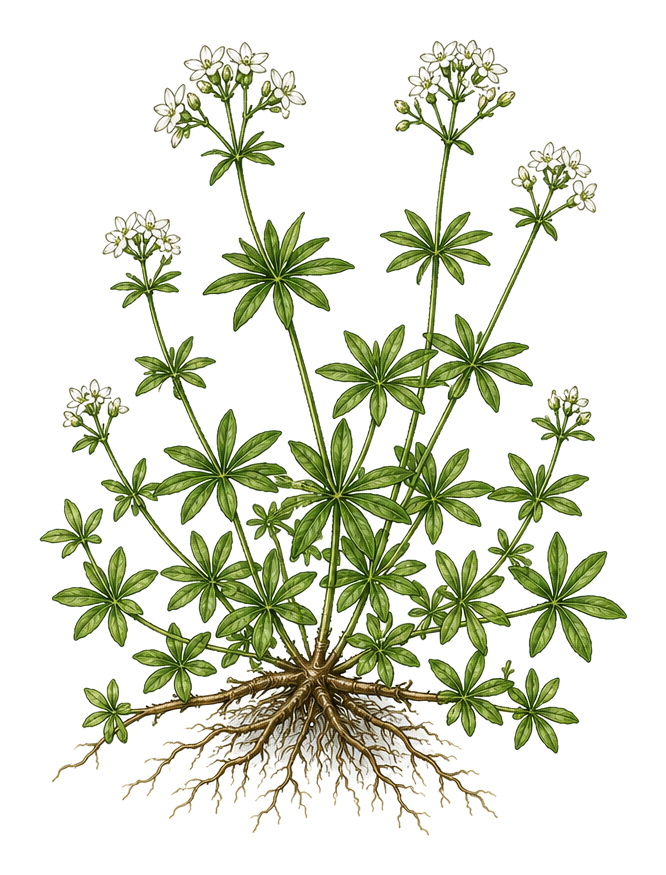
Sweet woodruff (Galium odoratum) is a perennial herbaceous plant, primarily known for its sweet, vanilla-like aroma that develops upon wilting or drying of the leaves. Native to European deciduous forests, it is a popular groundcover for shady garden areas. Traditionally, it is used to flavor beverages like May punch (Maibowle), as well as for desserts and teas.
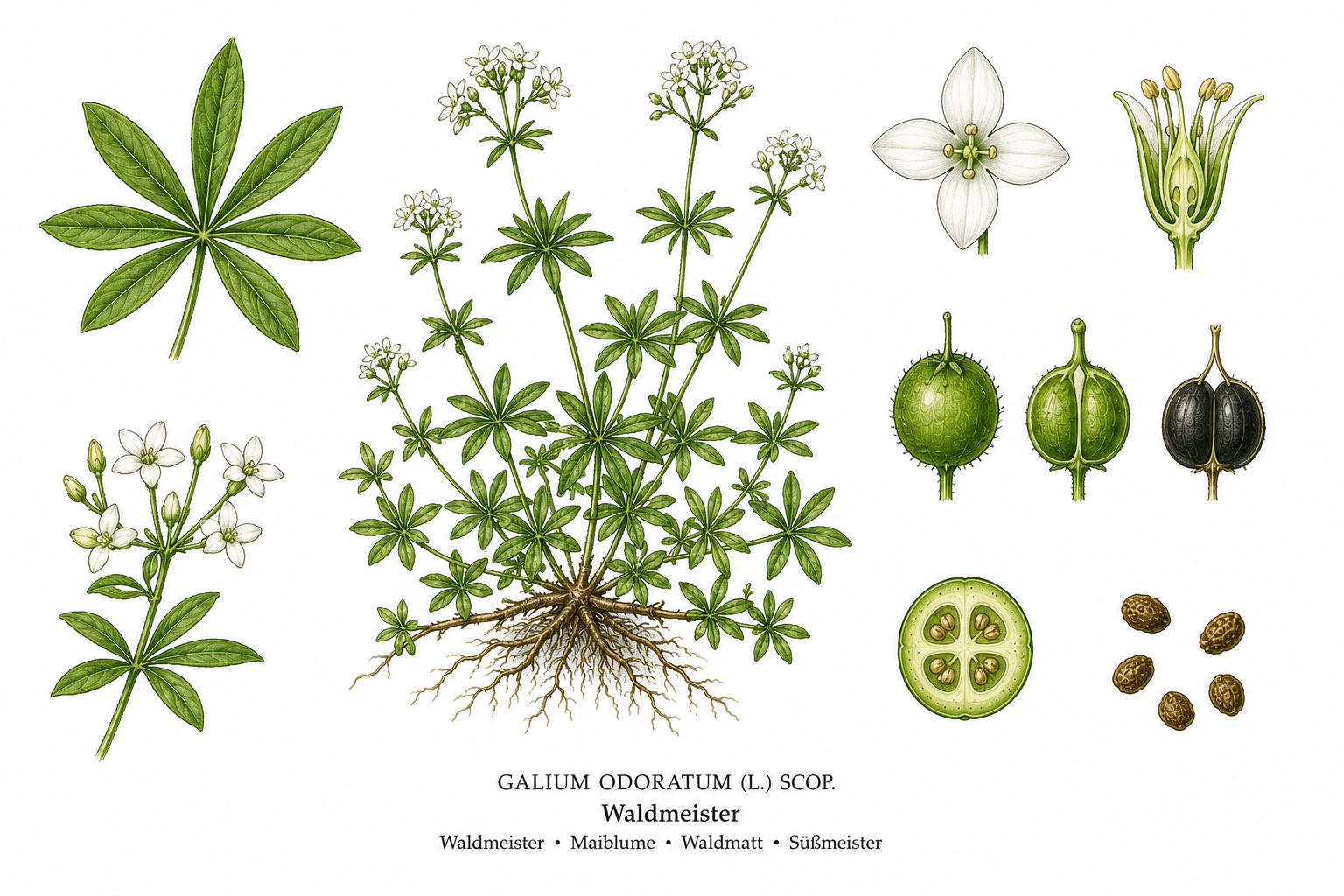
sweet woodruff (Galium odoratum): plant portrait for plant portrait - Madder family, Harvest Apr, May, Direct sowing Mar
sweet woodruff: plant portrait. harvest: Apr, May.

Quick profile

Key data

Planting

Mar, Apr, Sep, Oct

Harvest

Apr, May

Water

medium

Good neighbors

HostaFerns

Avoid

No data

Growing data

sweet woodruff Growing data

Seed depth

0.5 - 1 cm

Plant spacing

20 - 30 cm

Germination temp

5 - 12 °C

Sowing and germination

Seed depth0.5 - 1 cm
Germination temp5 - 12 °C
Germination time20 - 40 days
Seed viability2 - 3 years
Light germinatorNo
Dark germinatorNo
Cold germinatorYes
Stratification neededYes
Pre-soaking recommendedNo
Direct sowing possibleYes
Pre-culture recommendedNo

Planting and spacing

Plant spacing20 - 30 cm
Plants per m²10 - 15 per m²
Spacing1 per square

Temperature and site

Soil temperature5 - 10 °C
Growing temperaturefrom -20 °C
Optimal temperature15 - 20 °C
Frost sensitiveNo
Late frost sensitiveNo
Heat tolerancelow
Cold tolerancevery_high

Water, nutrients and care

Watermedium
Critical water phasesDuring establishment, During dry periods
Watering methodfrom_below
Droughthigh
Waterlogging sensitiveYes
Mulching recommendedYes
Nutrient needlight_feeder
Compost recommendedYes
Fertilizer sensitivitymedium

Container, support and growth

Container suitableYes
Pot sizeVolume: from 3 l; Recommended: from 5 l; Diameter: from 20 cm; Depth: from 15 cm
SupportNo
Height15 - 30 cm
Width30 - 60 cm
Root depth10 - 20 cm
Root spread30 - 60 cm

Year plan

sweet woodruff Calendar

All plants
Indoor sowingDirect sowingPlantingHarvest

Indoor sowing

No data

Sweet woodruff is typically not pre-cultivated indoors but sown directly or propagated by division.

Direct sowing

MarAprSepOct

Sow in spring or autumn. Sweet woodruff is a cold germinator and requires a cold period for germination.

Planting

MarAprSepOct

Planting of young plants or division of existing clumps in spring or autumn.

Harvest

AprMay

Leaves are harvested before flowering when the coumarin content is highest.

Year plan
  1. Outdoor sowing
  2. Planting / Dividing
  3. Outdoor sowing
  4. Planting / Dividing
  5. Harvest (leaves)
  6. Watering during dry spells
  7. Watering during dry spells
  8. Watering during dry spells
  9. Outdoor sowing
  10. Planting / Dividing
  11. Outdoor sowing
  12. Planting / Dividing

Growing

sweet woodruff Site, soil and care

Spacing

20 - 30 cm

Storage

Storage methods: Drying, Freezing (leaves), Storage duration: Dried: 6-12 months; Frozen: up to 6 months, Notes: For the best aroma, sweet woodruff should be dried. Fresh leaves only keep for a short time in the refrigerator.

Sweet woodruff is a low-maintenance plant that works well as a groundcover. Ensure a shady to partial shade location with moist, humus-rich soil. Propagation is easiest by dividing rhizomes in spring or autumn. Harvest leaves before flowering for the best aroma. Use with caution in large quantities due to coumarin content.

Pruning

sweet woodruff Pruning

not_applicable

Goal

not_applicable

Tools and hygiene

Clean tools are recommended for general plant hygiene, but not critical for sweet woodruff as it is robust and regenerates quickly.

Companion guide

sweet woodruff Companion guide

Companion guide

Good neighbors

HostaFerns

Avoid

No data

Health

Pests, Diseases

FAQ

Where does sweet woodruff grow best?

Sweet woodruff prefers a shady to partial shade location with moist, humus-rich, and well-drained soil. Locations under trees or shrubs are ideal.

When and how should sweet woodruff be harvested?

Leaves should be harvested before flowering, ideally in April or early May. Cut the stems just above the ground. The aroma develops best when the harvested stems are slightly wilted.

Is sweet woodruff poisonous?

Sweet woodruff contains coumarin, which can be liver-damaging in high doses. However, in the usual quantities for culinary purposes (e.g., May punch), it is harmless. Excessive consumption should be avoided, especially by pregnant women or individuals with liver problems.

How do you propagate sweet woodruff?

The easiest method is by dividing the rhizomes in spring or autumn. Sweet woodruff can also be propagated by sowing in autumn, as it is a cold germinator.

Related plants

Madder family

Same family

Belongs to the Rubiaceae family.

Sources

Public sources

  1. Wikidata entity

    Wikidata · 2026-05-15

  2. GBIF species match

    GBIF · 2026-05-15

  3. Deutschsprachige Wikipedia: Waldmeister

    Wikipedia · 2026-05-15

  4. English Wikipedia: Galium odoratum

    Wikipedia · 2026-05-15

Details

More public plant data

Names
Common

sweet woodruff

Plural

sweet woodruff

BotanicalGalium odoratum
Botanical author(L.) Scop.
Scientific synonyms
  1. Asperula odorata var. trifida
  2. Asperula odorata
  3. Galium odoratum var. eugeniae
  4. Asperula odora
  5. Asterophyllum sylvaticum
  6. Galium matrisylva
  7. Asperula eugeniae
  8. Asterophyllum asperula
  9. Chlorostemma odoratum
  10. Asperula matrisylva
Synonyms
  1. Galium odoratum
  2. woodruff
  3. sweetscented bedstraw
  4. Asperula odorata var. trifida
  5. Asperula odorata
  6. Galium odoratum var. eugeniae
  7. Asperula odora
  8. Asterophyllum sylvaticum
  9. Galium matrisylva
  10. Asperula eugeniae
  11. Asterophyllum asperula
  12. Chlorostemma odoratum
  13. Asperula matrisylva
Common synonyms
  1. woodruff
  2. sweetscented bedstraw
Regional names
Historical names
Market names
Misspellings
International names
La
  1. Galium odoratum
Ambiguous names
  1. NameWaldmeister
    Languagede
    Shared with
    1. Q7961534
    2. Q109565295
    3. Q116850725
    Clarification

    operetta by Johann Strauss, street in Berlin-Grunewald, family name

  2. NameWaldmeister
    Languageen
    Shared with
    1. Q7961534
    2. Q109565295
    3. Q3565320
    4. Q116850725
    Clarification

    operetta by Johann Strauss, street in Berlin-Grunewald, alcoholic drink, family name

Search terms
  1. sweet woodruff
Taxonomy
KingdomPlantae
OrderGentianales
Family botanicalRubiaceae
Family

Madder family

Family idrubiaceae
GenusGalium
Speciesodoratum
Hybrid statusnot_hybrid
Classification
Life cyclePerennial
Perennialyes
Woodyno
Treeno
Shrubno
Edible parts
  1. leaves
  2. flowers
Calendar
Sowing indoor
Notes

Sweet woodruff is typically not pre-cultivated indoors but sown directly or propagated by division.

Sowing outdoor
Months
  1. 3
  2. 4
  3. 9
  4. 10
Earliest month3
Latest month10
Notes

Sow in spring or autumn. Sweet woodruff is a cold germinator and requires a cold period for germination.

Planting out
Months
  1. 3
  2. 4
  3. 9
  4. 10
Earliest month3
Latest month10
Notes

Planting of young plants or division of existing clumps in spring or autumn.

Harvest
Months
  1. 4
  2. 5
Earliest month4
Latest month5
Notes

Leaves are harvested before flowering when the coumarin content is highest.

Month tasks
3
  1. Outdoor sowing

  2. Planting / Dividing

4
  1. Outdoor sowing

  2. Planting / Dividing

  3. Harvest (leaves)

5
  1. Harvest (leaves)

6
  1. Watering during dry spells

7
  1. Watering during dry spells

8
  1. Watering during dry spells

9
  1. Outdoor sowing

  2. Planting / Dividing

10
  1. Outdoor sowing

  2. Planting / Dividing

Month tasks structured
3
  1. Tasksow_outdoor
    Label

    Outdoor sowing

    Prioritymedium
    Months
    1. 3
    2. 4
    3. 9
    4. 10
    ConditionBodentemperatur über 5°C
    Estimated effortlow
    Notes

    Sweet woodruff is a cold germinator and requires a cold period for germination. Direct sowing in spring or autumn is ideal.

  2. Taskplant
    Label

    Planting / Dividing

    Prioritymedium
    Months
    1. 3
    2. 4
    3. 9
    4. 10
    Conditionfrostfreier Boden
    Estimated effortmedium
    Notes

    Best time to plant young plants or divide existing clumps to encourage spread.

4
  1. Tasksow_outdoor
    Label

    Outdoor sowing

    Prioritymedium
    Months
    1. 3
    2. 4
    3. 9
    4. 10
    ConditionBodentemperatur über 5°C
    Estimated effortlow
    Notes

    Sweet woodruff is a cold germinator and requires a cold period for germination. Direct sowing in spring or autumn is ideal.

  2. Taskplant
    Label

    Planting / Dividing

    Prioritymedium
    Months
    1. 3
    2. 4
    3. 9
    4. 10
    Conditionfrostfreier Boden
    Estimated effortmedium
    Notes

    Best time to plant young plants or divide existing clumps to encourage spread.

  3. Taskharvest
    Label

    Harvest (leaves)

    Priorityhigh
    Months
    1. 4
    2. 5
    Conditionvor der Blüte
    Estimated effortlow
    Notes

    Harvest leaves before flowering, as the coumarin content is highest and the aroma most intense then.

5
  1. Taskharvest
    Label

    Harvest (leaves)

    Priorityhigh
    Months
    1. 4
    2. 5
    Conditionvor der Blüte
    Estimated effortlow
    Notes

    Harvest leaves before flowering, as the coumarin content is highest and the aroma most intense then.

6
  1. Taskwater
    Label

    Watering during dry spells

    Prioritymedium
    Months
    1. 6
    2. 7
    3. 8
    ConditionBoden trocken
    Estimated effortlow
    Notes

    Sweet woodruff prefers moist soil; water regularly, especially during dry periods.

7
  1. Taskwater
    Label

    Watering during dry spells

    Prioritymedium
    Months
    1. 6
    2. 7
    3. 8
    ConditionBoden trocken
    Estimated effortlow
    Notes

    Sweet woodruff prefers moist soil; water regularly, especially during dry periods.

8
  1. Taskwater
    Label

    Watering during dry spells

    Prioritymedium
    Months
    1. 6
    2. 7
    3. 8
    ConditionBoden trocken
    Estimated effortlow
    Notes

    Sweet woodruff prefers moist soil; water regularly, especially during dry periods.

9
  1. Tasksow_outdoor
    Label

    Outdoor sowing

    Prioritymedium
    Months
    1. 3
    2. 4
    3. 9
    4. 10
    ConditionBodentemperatur über 5°C
    Estimated effortlow
    Notes

    Sweet woodruff is a cold germinator and requires a cold period for germination. Direct sowing in spring or autumn is ideal.

  2. Taskplant
    Label

    Planting / Dividing

    Prioritymedium
    Months
    1. 3
    2. 4
    3. 9
    4. 10
    Conditionfrostfreier Boden
    Estimated effortmedium
    Notes

    Best time to plant young plants or divide existing clumps to encourage spread.

10
  1. Tasksow_outdoor
    Label

    Outdoor sowing

    Prioritymedium
    Months
    1. 3
    2. 4
    3. 9
    4. 10
    ConditionBodentemperatur über 5°C
    Estimated effortlow
    Notes

    Sweet woodruff is a cold germinator and requires a cold period for germination. Direct sowing in spring or autumn is ideal.

  2. Taskplant
    Label

    Planting / Dividing

    Prioritymedium
    Months
    1. 3
    2. 4
    3. 9
    4. 10
    Conditionfrostfreier Boden
    Estimated effortmedium
    Notes

    Best time to plant young plants or divide existing clumps to encourage spread.

Book content
Overview

Sweet woodruff (Galium odoratum) is a perennial herbaceous plant, primarily known for its sweet, vanilla-like aroma that develops upon wilting or drying of the leaves. Native to European deciduous forests, it is a popular groundcover for shady garden areas. Traditionally, it is used to flavor beverages like May punch (Maibowle), as well as for desserts and teas.

Structured month tasks
3
  1. Tasksow_outdoor
    Label

    Outdoor sowing

    Prioritymedium
    Months
    1. 3
    2. 4
    3. 9
    4. 10
    ConditionBodentemperatur über 5°C
    Estimated effortlow
    Notes

    Sweet woodruff is a cold germinator and requires a cold period for germination. Direct sowing in spring or autumn is ideal.

  2. Taskplant
    Label

    Planting / Dividing

    Prioritymedium
    Months
    1. 3
    2. 4
    3. 9
    4. 10
    Conditionfrostfreier Boden
    Estimated effortmedium
    Notes

    Best time to plant young plants or divide existing clumps to encourage spread.

4
  1. Tasksow_outdoor
    Label

    Outdoor sowing

    Prioritymedium
    Months
    1. 3
    2. 4
    3. 9
    4. 10
    ConditionBodentemperatur über 5°C
    Estimated effortlow
    Notes

    Sweet woodruff is a cold germinator and requires a cold period for germination. Direct sowing in spring or autumn is ideal.

  2. Taskplant
    Label

    Planting / Dividing

    Prioritymedium
    Months
    1. 3
    2. 4
    3. 9
    4. 10
    Conditionfrostfreier Boden
    Estimated effortmedium
    Notes

    Best time to plant young plants or divide existing clumps to encourage spread.

  3. Taskharvest
    Label

    Harvest (leaves)

    Priorityhigh
    Months
    1. 4
    2. 5
    Conditionvor der Blüte
    Estimated effortlow
    Notes

    Harvest leaves before flowering, as the coumarin content is highest and the aroma most intense then.

5
  1. Taskharvest
    Label

    Harvest (leaves)

    Priorityhigh
    Months
    1. 4
    2. 5
    Conditionvor der Blüte
    Estimated effortlow
    Notes

    Harvest leaves before flowering, as the coumarin content is highest and the aroma most intense then.

6
  1. Taskwater
    Label

    Watering during dry spells

    Prioritymedium
    Months
    1. 6
    2. 7
    3. 8
    ConditionBoden trocken
    Estimated effortlow
    Notes

    Sweet woodruff prefers moist soil; water regularly, especially during dry periods.

7
  1. Taskwater
    Label

    Watering during dry spells

    Prioritymedium
    Months
    1. 6
    2. 7
    3. 8
    ConditionBoden trocken
    Estimated effortlow
    Notes

    Sweet woodruff prefers moist soil; water regularly, especially during dry periods.

8
  1. Taskwater
    Label

    Watering during dry spells

    Prioritymedium
    Months
    1. 6
    2. 7
    3. 8
    ConditionBoden trocken
    Estimated effortlow
    Notes

    Sweet woodruff prefers moist soil; water regularly, especially during dry periods.

9
  1. Tasksow_outdoor
    Label

    Outdoor sowing

    Prioritymedium
    Months
    1. 3
    2. 4
    3. 9
    4. 10
    ConditionBodentemperatur über 5°C
    Estimated effortlow
    Notes

    Sweet woodruff is a cold germinator and requires a cold period for germination. Direct sowing in spring or autumn is ideal.

  2. Taskplant
    Label

    Planting / Dividing

    Prioritymedium
    Months
    1. 3
    2. 4
    3. 9
    4. 10
    Conditionfrostfreier Boden
    Estimated effortmedium
    Notes

    Best time to plant young plants or divide existing clumps to encourage spread.

10
  1. Tasksow_outdoor
    Label

    Outdoor sowing

    Prioritymedium
    Months
    1. 3
    2. 4
    3. 9
    4. 10
    ConditionBodentemperatur über 5°C
    Estimated effortlow
    Notes

    Sweet woodruff is a cold germinator and requires a cold period for germination. Direct sowing in spring or autumn is ideal.

  2. Taskplant
    Label

    Planting / Dividing

    Prioritymedium
    Months
    1. 3
    2. 4
    3. 9
    4. 10
    Conditionfrostfreier Boden
    Estimated effortmedium
    Notes

    Best time to plant young plants or divide existing clumps to encourage spread.

Cultivation specs
Seed
Seed depth cm min.0.5
Seed depth cm max.1
Light germinatorno
Dark germinatorno
Cold germinatoryes
Stratification neededyes
Pre soaking recommendedno
Germination temperature c min.5
Germination temperature c max.12
Germination days min.20
Germination days max.40
Seed lifespan years min.2
Seed lifespan years max.3
Direct sowing possibleyes
Pre culture recommendedno
Spacing
Plant spacing cm min.20
Plant spacing cm max.30
Recommended density per sqm min.10
Recommended density per sqm max.15
Square foot gardening spacing1 per square
Spacing notes

Sweet woodruff spreads by rhizomes, forming dense carpets. Allow enough space for its spread.

Growth dimensions
Height cm min.15
Height cm max.30
Width cm min.30
Width cm max.60
Root depth cm min.10
Root depth cm max.20
Root spread cm min.30
Root spread cm max.60
Growth speedmedium
Final size notes

Forms dense, ground-covering mats over time.

Temperature
Min. growing temperature-20 °C
Optimal temperature c min.15
Optimal temperature c max.20
Max. heat tolerance25 °C
Soil temperature for sowing c min.5
Soil temperature for sowing c optimal10
Frost sensitiveno
Late frost sensitiveno
Heat tolerancelow
Cold tolerancevery_high
Temperature notes

Prefers cool, shady locations and is very winter-hardy. Tolerates heat and direct sun poorly.

Water
Water needmedium
Critical water phases
  1. During establishment
  2. During dry periods
Drought tolerantno
Drought sensitivityhigh
Waterlogging sensitiveyes
Mulching recommendedyes
Water notes

The soil should always be moist but not waterlogged. Avoid waterlogging at all costs.

Nutrition
Nutrient grouplight_feeder
Heavy feederno
Medium feederno
Light feederyes
Nitrogen needlow
Phosphorus needlow
Potassium needlow
Calcium needmedium
Magnesium needlow
Compost recommendedyes
Mulching recommendedyes
Fertilizer sensitivitymedium
Nutrition notes

Requires few nutrients. An annual application of compost in spring is sufficient.

Container
Container suitableyes
Min. pot volume3 l
Recommended pot volume5 l
Min. pot depth15 cm
Min. pot diameter20 cm
Plants per container min.1
Plants per container max.3
Drainage requiredyes
Repotting neededno
Container notes

In pots, ensure consistent moisture and good drainage. Regular division may be necessary.

Support
Needs supportno
Support recommendedno
Climbingno
Viningno
Trellis recommendedno
Training requiredno
Support notes

As a ground-covering plant, sweet woodruff does not require support.

Cultivation modes
Outdoor bed suitableyes
Raised bed suitableyes
Container suitableyes
Balcony suitableyes
Greenhouse suitableno
Polytunnel suitableno
Indoor suitableno
Windowsill suitableno
Hydroponic possibleno
Permaculture suitableyes
No dig suitableyes
Yield density
Yield unitg
Yield reliabilityhigh
Yield notes

Yield refers to harvested leaves. An established planting reliably provides harvest.

Site
Sunlight exposure
  1. Shade
  2. Partial shade
Wind exposure

Sheltered

Site notes

Prefers locations under trees or shrubs that protect from direct midday sun.

Soil
Soil type
  1. Humus-rich
  2. Loamy
PH level min.5.5
PH level max.7
PH preference

Slightly acidic to neutral

Soil structure
  1. Loose
  2. Well-drained
Soil notes

Moist, well-drained, and humus-rich forest soil is ideal.

Watering
Water needmedium
Watering frequency

Regularly, especially during dry periods

Watering method

From below or gently overhead

Mulching recommendedyes
Drought tolerancelow
Waterlogging tolerancelow
Watering notes

The soil should never completely dry out, but waterlogging must be avoided.

Nutrition
Nutrient grouplight_feeder
Fertilizer type
  1. Compost
Fertilizer frequency

Annually in spring

Fertilizer notes

A thin layer of compost in spring is sufficient to meet nutrient requirements.

Compost recommendedyes
Mulching recommendedyes
Cultivation planning
Succession sowing
Possibleno
Bed planning notes

Excellent ground cover for shady areas under trees and shrubs. Can spread vigorously.

Rotation prioritynot_applicable
Interplanting potentialhigh
Mechanization relevancelow
Problems
Common
  1. too sunny a site
  2. drying out
  3. excessive spreading
Diagnosis

Check water, site, nutrition, and pest pressure first.

Problem management
Common pest groups
Common disease groups
Prevention principles
  1. Site-appropriate planting (shade, moist, humus-rich soil)
  2. Avoidance of waterlogging
  3. Regular monitoring for dryness, especially during hot periods
  4. Containment of spread if necessary through root barriers or regular division
Diagnosis notes

Most problems with sweet woodruff are due to unsuitable site conditions or care errors, not specific pests or diseases. Pay attention to the plant's needs regarding light, water, and soil.

Disease graph
Scopecrop_specific
Profiles
  1. Slugroot_rot
    Severityhigh
    Conditions
    1. Persistent waterlogging
    2. Poor soil drainage
    Affected parts
    1. Roots
    2. Stem base
    3. Leaves (wilting, yellowing)
    Prevention
    1. Ensure good soil drainage
    2. Avoid overwatering
    3. Improve soil structure with compost
    Organic control
    1. Improve drainage
    2. Adjust watering schedule
    3. Remove severely affected plants
Diagnostic rules
  1. Symptom

    Leaves turn yellow or brown

    Possible causes
    1. Too much direct sun
    2. Insufficient water
    3. Nutrient deficiency (less likely)
    First checks
    1. Check sunlight exposure
    2. Check soil moisture
    3. Check soil quality
  2. Symptom

    Plant wilts despite moist soil

    Possible causes
    1. Root rot
    First checks
    1. Check for waterlogging
    2. Examine roots for mushiness
  3. Symptom

    Poor growth / Stunted plants

    Possible causes
    1. Too much sun
    2. Too dry soil
    3. Poor soil quality
    4. Competition from other plants
    First checks
    1. Check site conditions (shade, moisture)
    2. Check soil for humus content
    3. Assess competition from other plants
Prevention strategy
Cultural
  1. Choose a shady to partial shade location
  2. Ensure humus-rich, well-drained soil
  3. Maintain consistent soil moisture, but avoid waterlogging
  4. Mulch the soil to retain moisture and suppress weeds
Monitoring
  1. Regularly check soil moisture
  2. Observe leaves for discoloration or wilting
Organic first response
  1. Adjust watering schedule (less for waterlogging, more for dryness)
  2. Improve drainage if waterlogging is present
  3. Provide more shade if leaves are scorched
Notes

Sweet woodruff is generally very robust when grown in a suitable location with the right conditions. Most problems can be resolved by adjusting the environment.

Phenology
Stages
  1. Spring emergence
  2. Leaf development
  3. Flower bud formation
  4. Flowering
  5. Fruiting
  6. Seed ripening
  7. Autumn dieback (aerial parts die, rhizomes overwinter)
Notes

Leaves are harvested before flowering, as coumarin content and aroma are most intense then. After flowering, the aroma diminishes.

Flowering pollination
Flowering period

May to June

Flower color
  1. White
Flower type

Small, star-shaped flowers in loose cymes

Inflorescence

Cyme

Notes

The small white flowers appear in clusters above the foliage and are rather inconspicuous.

Harvest
Harvest parts
  1. Leaves
  2. Flowers (rarely)
Harvest months
  1. 4
  2. 5
Harvest notes

Leaves are ideally harvested in April or early May, just before the plant begins to flower. At this time, the coumarin content is highest and the aroma is most intense. After flowering, the aroma diminishes, and coumarin content may change.

Harvest details
Harvest frequency

Once annually for the main harvest, light harvesting possible as needed.

Harvest indicators
  1. Fresh, green leaves
  2. Before flower buds open
Post harvest handling

Tie harvested stems into small bundles and hang upside down in an airy, shady place to dry. Alternatively, spread them on a rack. After drying, strip the leaves from the stems.

Storage
Storage methods
  1. Drying
  2. Freezing (leaves)
Storage duration

Dried: 6-12 months; Frozen: up to 6 months

Notes

For the best aroma, sweet woodruff should be dried. Fresh leaves only keep for a short time in the refrigerator.

Storage details
General storage category

Dried herbs

Storage life

Dried sweet woodruff retains its aroma in an airtight container in a dark, cool place for 6 to 12 months.

Processing options
  1. Drying for tea or punch
  2. Freezing in ice cubes for drinks
  3. Making syrup or extract
Processing use
Primary processing

Drying the leaves for flavoring drinks and dishes.

Secondary processing

Production of sweet woodruff syrup, extract, or spirit. Leaves are often slightly wilted to intensify the aroma.

Notes

Sweet woodruff's characteristic aroma only develops when the leaves wilt or dry, as coumarin is released.

Kitchen usage
Culinary uses
  1. May punch (Maibowle)
  2. Sweet woodruff syrup
  3. Jelly
  4. Desserts (pudding, ice cream)
  5. Lemonades
  6. Tea
Flavor profile

Sweet, vanilla-like, hay-like, slightly bitter

Pairing suggestions
  1. White wine
  2. Sparkling wine
  3. Fruits (strawberries)
  4. Cream
  5. Curd cheese
Preparation methods

Fresh or dried leaves are steeped in liquids (wine, water, milk) for a short time to extract the aroma. Do not boil to avoid bitterness.

Notes

Sweet woodruff should be used sparingly, especially in larger quantities, as it contains coumarin. For May punch, the slightly wilted stems are briefly steeped in wine.

Safety and edibility
Edible parts
  1. Leaves
  2. Flowers (in small quantities)
Inedible or caution parts
  1. High doses of leaves (due to coumarin)
Toxicity notes

Sweet woodruff contains coumarin, which can be liver-damaging in high doses. Coumarin content is highest before flowering. Moderate consumption is safe, but excessive intake should be avoided. Pregnant women and individuals with liver conditions should be particularly cautious.

Raw consumption

Yes, in moderation. Leaves are often slightly wilted or dried to intensify the aroma and stabilize coumarin content.

Seed saving
Seed maturity indicators

The small, spherical fruits (schizocarps) turn brown and dry and detach easily.

Harvest method

Carefully collect seed heads by hand as soon as they are ripe. They can fall off easily, so regular checking is important.

Cleaning method

Gently rub the dried seed heads to separate the seeds from the husks. Sieve out chaff and other plant material.

Storage conditions

Store dry, cool, and dark in an airtight container.

Notes

Sweet woodruff often self-seeds if conditions are right. Seeds require a cold period (cold germinator) for germination.

Seed saving advanced
Special considerations

Seeds require cold stratification to germinate. This can be achieved by sowing in autumn or artificial stratification.

Notes

Vegetative propagation by dividing rhizomes is easier and more reliable than seed saving for home gardens.

Woody crop details
Rootstock relevancenot_applicable
Renewal pruning relevancenot_applicable
Notes

Sweet woodruff is a herbaceous, strongly spreading plant and not a woody variety in the classic sense. The information provided here relates to general cultivation and propagation.

Ecology
Pollinator valuelow
Wildlife valuelow
Biodiversity notes

While not a primary food source for wildlife, sweet woodruff provides habitat for small insects as a groundcover and improves soil structure.

Practical notes

Sweet woodruff is a low-maintenance plant that works well as a groundcover. Ensure a shady to partial shade location with moist, humus-rich soil. Propagation is easiest by dividing rhizomes in spring or autumn. Harvest leaves before flowering for the best aroma. Use with caution in large quantities due to coumarin content.

Seasonal content
Spring

In spring, sweet woodruff emerges and is ready for harvesting its aromatic leaves before flowering. This is also the best time to propagate new plants by division.

Summer

In summer, sweet woodruff requires regular watering during dry spells to maintain its green color and vitality. It serves as an attractive groundcover.

Autumn

Autumn is a good time to divide and plant sweet woodruff. The above-ground parts die back, but the rhizomes overwinter well.

Winter

Sweet woodruff is winter-hardy. The above-ground parts die back, and the roots survive the winter in the soil.